Computational antibody design software helps you number, analyze, and redesign antibody sequences and structures without running every step by hand. Nanome is a collaborative molecular visualization and drug discovery platform (web app, XR headsets) that runs antibody workflows through its agents and lets you review the results in 3D. Its AI copilot, MARA, can define CDR loops with ANARCI, generate new sequences with ProteinMPNN, and predict structures with Boltz-2 or AlphaFold 3, then report which tool it called and what came back.
What computational antibody design actually involves
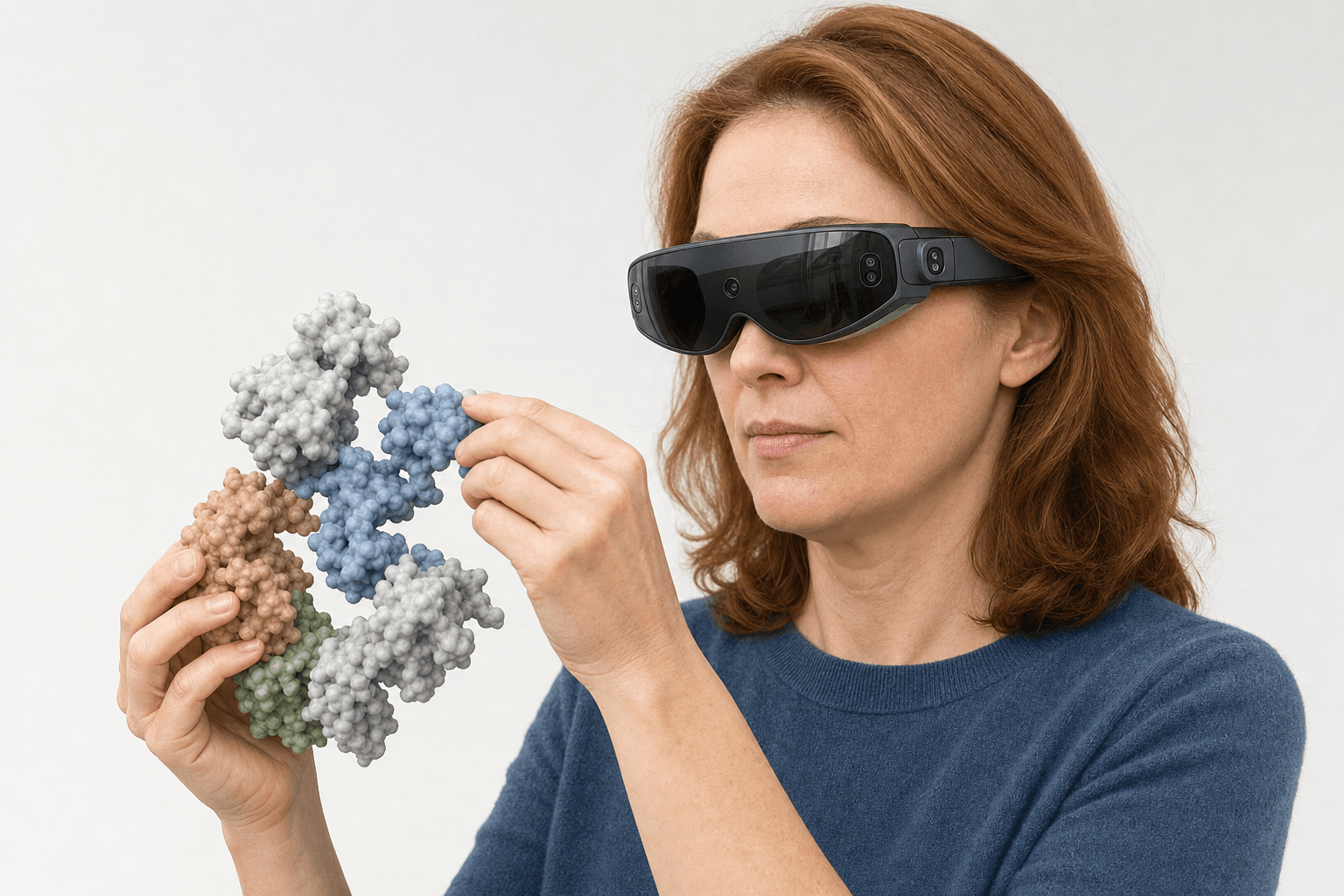 A researcher wearing an ultra-thin VR headset studies a antibody-antigen complex rendered as a solid molecular surface held close to the chest
The work breaks into a few concrete steps, and good software covers all of them.
Numbering and CDR analysis. An antibody variable domain carries framework regions plus 3 complementarity-determining regions (CDRs) per chain, and those CDRs do most of the antigen binding. Before anything gets compared or engineered, the sequence gets numbered under a standard scheme (Kabat, Chothia, IMGT, AHo), which is ANARCI's job. The numbering marks where each CDR starts and stops, so two antibodies line up residue by residue and a mutation can be described by position rather than by eye.
Structure prediction. With a sequence in hand, the next thing you want is the fold. Boltz-2 and AlphaFold 3 each predict one, and the model shows how the CDR loops sit in space and which residues point at the antigen. Neither one settles a hard interface on its own.
Sequence design on a fixed backbone. ProteinMPNN holds a backbone steady and proposes sequences that should still fold to it. On an antibody that means keeping the framework and reshaping the CDR loops toward a target. ANARCI annotates a sequence; ProteinMPNN writes new ones.
Review. A predicted complex still gets a human look before it moves anywhere. Flattened onto a screen, a binding interface loses the depth that says whether a CDR loop reaches its epitope or only appears to from one camera angle, so bringing the complex into 3D surfaces the clashes and contacts a score leaves out. The viewers built for that step are surveyed in the best molecular visualization tools.
A real case: Lyme antibody prophylaxis
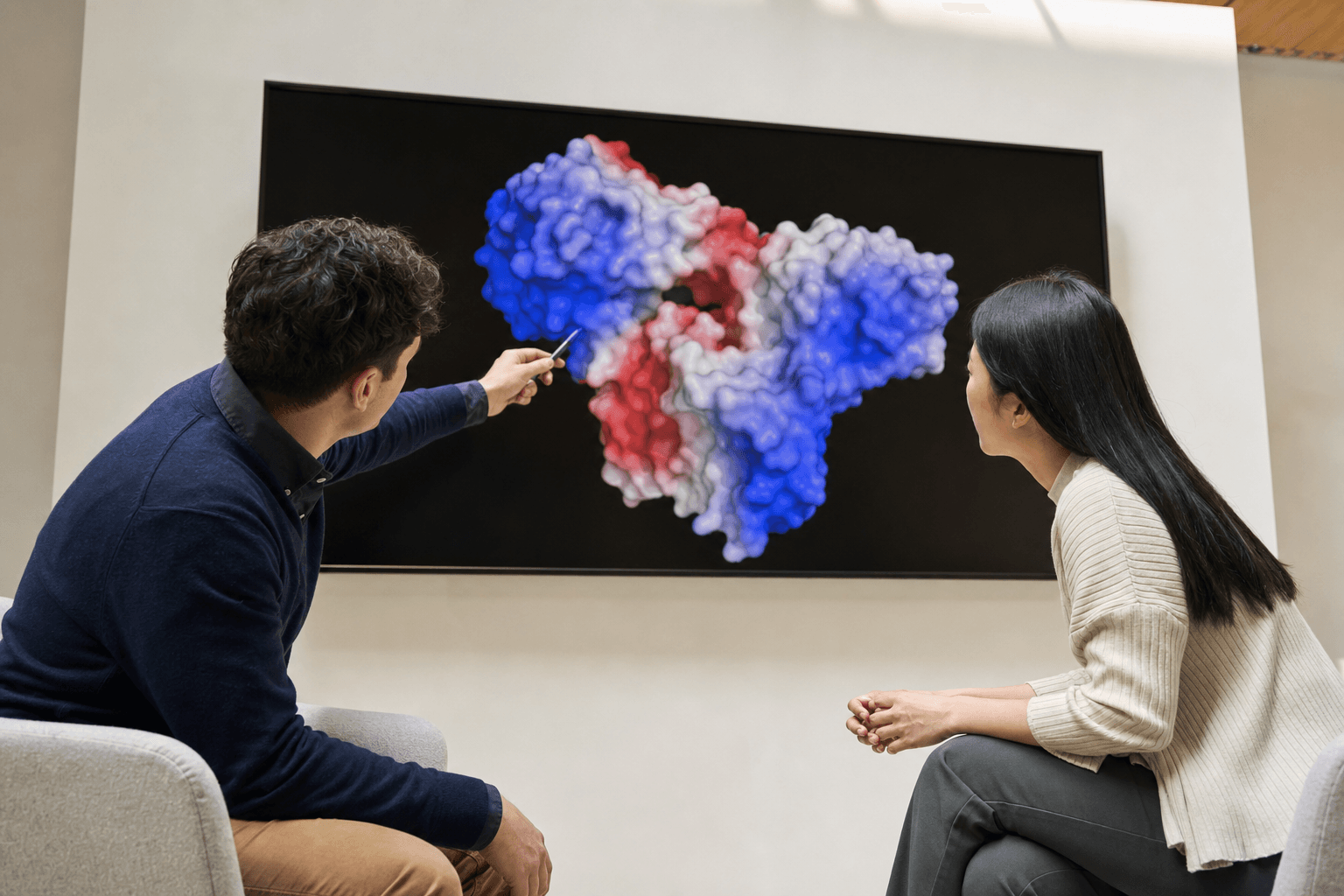 Two researchers review an antibody binding interface rendered as a molecular surface on a large wall display, one pointing to the binding pocket.
One antibody program run this way is prophylaxis for Lyme disease. The team worked on an antibody intended to stop the infection at exposure, before it can establish, and reviewed the binding structure in an immersive 3D setting to check how the antibody engages its target. That is the review step carrying weight: a live interface in front of you at the moment someone has to say whether the contacts hold up.
Where different tools fit


| Software | Its job in an antibody project | How Nanome connects |
|---|---|---|
| ANARCI | Numbering variable domains (Kabat, Chothia, IMGT, AHo) and marking CDR boundaries | MARA calls ANARCI on your sequence, and the numbered CDRs appear on the 3D structure |
| ProteinMPNN | Writing new sequences for a fixed backbone, which on an antibody means CDR redesign | MARA calls ProteinMPNN from a plain-English request, and the designs open in the workspace |
| Boltz-2, AlphaFold 3 | Predicting the folded antibody, on its own or alongside its antigen | MARA runs the prediction, and Nanome opens the result in a room the whole team can join |
| PyMOL, ChimeraX | Scripted, mostly single-seat structure viewing and figure work | Nanome adds live multiplayer review and native immersive 3D, in a headset or a browser tab |
| Schrödinger, MOE | Full desktop comp-chem suites, each with its own antibody modules | Both are listed Nanome integrations, so design stays where it is and the structures travel over for shared review |
Nanome and MARA for antibody workflows
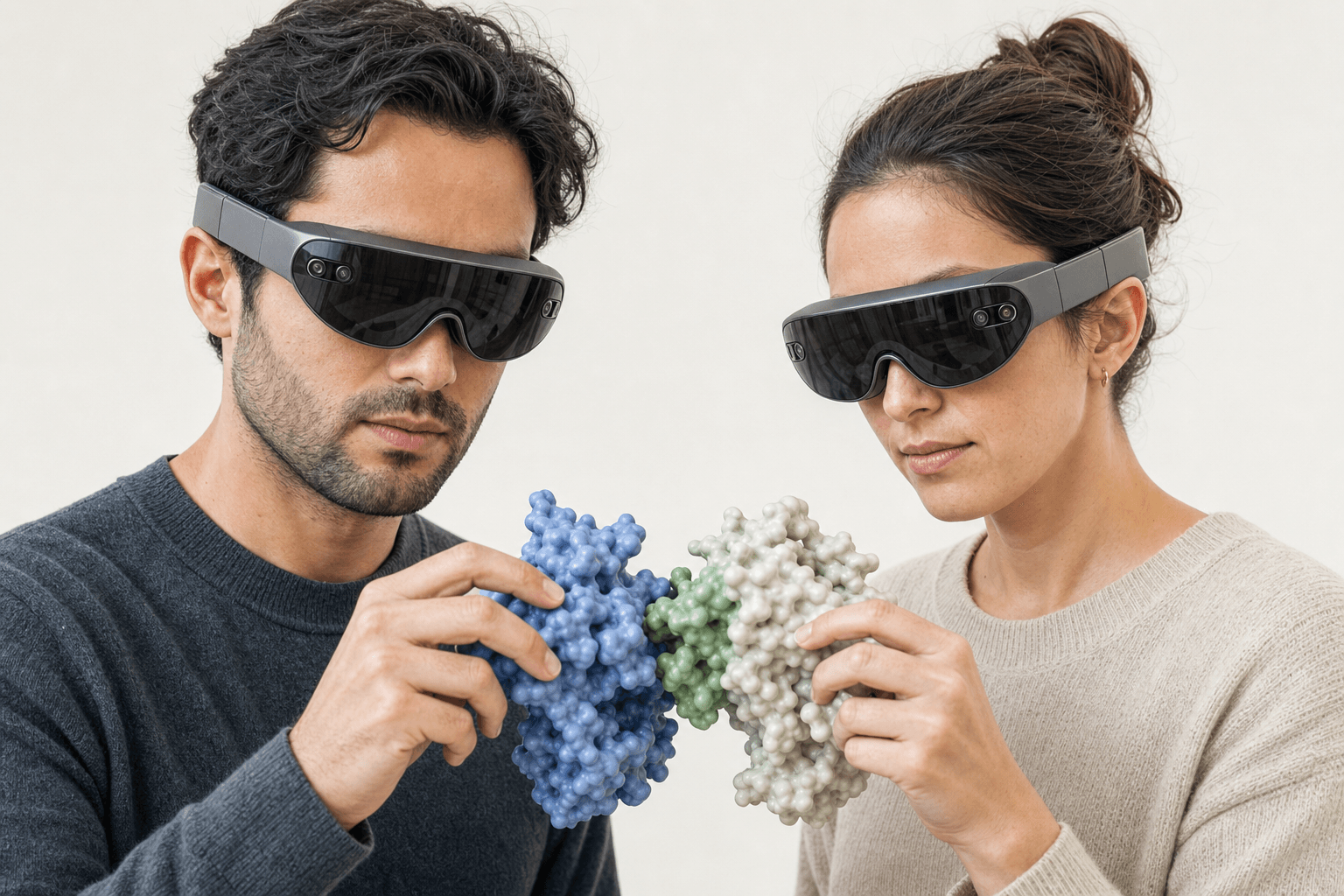 Two colleagues wearing ultra-thin VR headsets examine the same antibody-antigen complex rendered as a solid molecular surface floating between them
You ask for an antibody step in plain English, and MARA picks the tool: ANARCI for numbering, ProteinMPNN for CDR redesign, Boltz-2 or AlphaFold 3 for the fold. The catalogue reaches further when a program needs it, into docking on Smina and DiffDock-L, electrostatics with APBS, and de novo binder design with RFdiffusion3 (beta). Docked poses get reviewed the same way an antibody interface does, and software for molecular docking visualization covers that side of it. 300+ tools across 26 categories sit behind the same interface.
Provenance comes back with every run: the tool MARA called, what it was handed, and what it returned. A designed sequence or a predicted fold can be traced along that chain, which is what makes it usable in a project meeting where somebody will ask where the number came from.
Then the structure goes up in 3D. The antibody-antigen complex loads into a shared Nanome workspace, and colleagues walk the interface together in real time, on Apple Vision Pro, Meta Quest, Pico Neo, or HTC Vive Focus 3, on a Windows desktop, or in a browser tab with no headset involved. Structures arrive as .pdb, .cif, .sdf, .mol2, .xyz, or .pqr and stay editable once loaded, and RCSB PDB, PubChem, and DrugBank are one fetch away. More on supported formats.
Where a purpose-built suite is the better call
An antibody pipeline already scripted inside Schrödinger Maestro or MOE can stay put. Both are listed Nanome integrations, so the design work keeps running in the suite while the structures come across for shared review: Maestro .mae and .maegz files import, .maegz by way of the LiveDesign gadget, and MOE .moe files do too.
For a quick single-seat figure driven from a script, PyMOL or ChimeraX on the desktop is usually the faster route. PyMOL .pse sessions import for viewing, with limits worth knowing up front: link atoms from QM/MM work can break a session, and the validated PyMOL versions aren't documented. There's no .pse write-back either. What leaves Nanome is PDB, SDF, or SMILES, one frame at a time.
Antibody work is one lane of a wider computational stack, and drug discovery software for computational chemistry maps the rest of it. Write-ups of projects that ran this way are at nanome.ai/case-studies.
FAQ
What is the best antibody design software?
It depends on the step. ANARCI is the standard for numbering and CDR annotation. ProteinMPNN handles CDR redesign on a fixed backbone. Boltz-2 and AlphaFold 3 both predict the fold. Nanome drives all of them through MARA and adds collaborative 3D and XR review, so the running and the looking happen in the same place.
How do you design antibodies computationally?
You number the sequence and mark the CDRs with ANARCI, predict or load the 3D structure with Boltz-2 or AlphaFold 3, redesign the CDR loops on the backbone with ProteinMPNN, then review the binding interface in 3D before committing to anything. MARA drives each of those from a plain-English request.
Can I run these tools without writing code?
Yes. MARA takes the request in plain English, calls the underlying tool, and reports what ran and what came back. An open REST API and MCP servers are there for groups that would rather script it.
Does Nanome replace an antibody suite we already run?
No. Schrödinger LiveDesign and CCG MOE are both listed integrations. Nanome adds the multiplayer 3D and immersive review layer over what's already in place.