The best molecular visualization tools include PyMOL, UCSF ChimeraX, VMD, Schrödinger Maestro, MOE, BIOVIA Discovery Studio, Avogadro, and Nanome. Most of them are single-user desktop viewers or full computational chemistry suites. Nanome is the collaborative option: a molecular visualization and drug discovery platform that runs across the web app and XR headsets, and it integrates with the suites rather than trying to replace them. An AI copilot called MARA sits inside it and drives the tool runs.
That list has been stable for years, and the evergreen version of this comparison lives in the best molecular visualization tools. This page is about the date on it. Here are the 4 changes that landed during 2026 and what each one does to the moment a human finally looks at a structure.
The shortlist that carried over


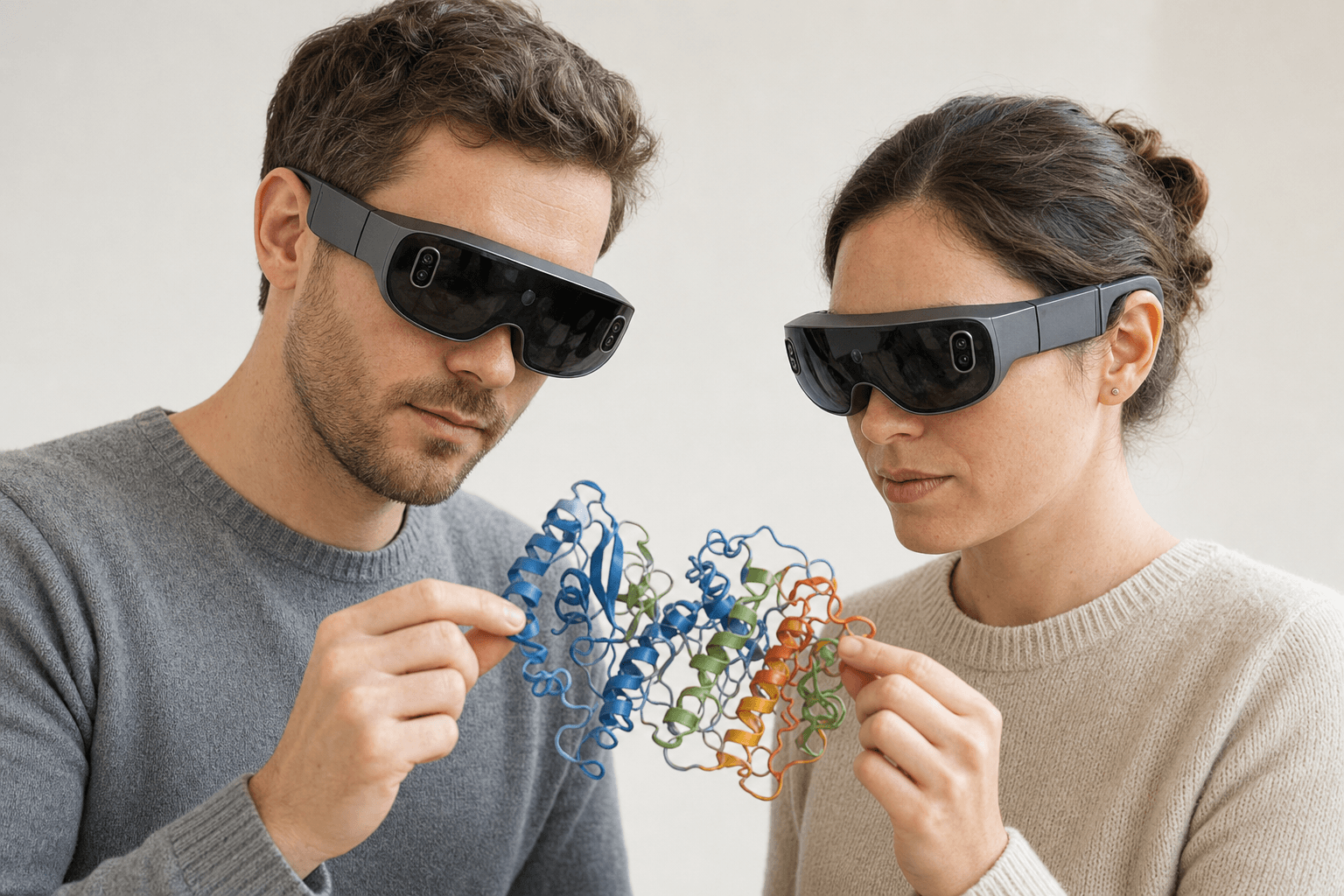 Two colleagues wearing ultra-thin VR headsets examine the same ribbon-cartoon protein structure floating between them
The desktop names on that list are the same ones as a year ago, and each still owns the job it was written for. The movement happened on either side of them: upstream, in how many structures a model can produce in an afternoon, and downstream, in how many people can stand around one of them.
| What moved in 2026 | The specifics | Effect on the review step |
|---|---|---|
| Co-folding | AlphaFold 3 held the reference position, with OpenFold3, Boltz-2, Chai-1, ESMFold and Protenix beside it, and the Boltz line ran on to BoltzMol-1 and BoltzProt-1 in June 2026 | Predicted complexes arrive faster than a one-at-a-time queue can clear them, and a run record has to carry the exact model name |
| Generative design | RFdiffusion3 (beta) open-sourced on 2026-01-14, all-atom, roughly 10x the inference speed of RFdiffusion2 | Binder candidates come in batches, so triage moves into 3D instead of going pose by pose |
| Headsets | Apple Vision Pro joined Meta Quest, Pico Neo and HTC Vive Focus 3 on the standalone side | Immersive review became a slot a group can put on the calendar every week |
| Nanome 2.5 | Frame playback, plus one live session spanning the browser web app and the headsets | A colleague joins from a laptop tab with nothing to install at their end |
Co-folding became a queue
AlphaFold 3 is the model that turned co-folding into an ordinary weekly task. One naming detail is worth getting right: the AlphaFold Protein Structure Database is a different resource with a similar name, and it serves the earlier AF2 predictions rather than AlphaFold 3 output.
The field kept walking after that. Boltz-1 arrived in November 2024 for structure, Boltz-2 added binding affinity, and in June 2026 BoltzMol-1 and BoltzProt-1 landed, with BoltzProt-1 taking over from BoltzGen. Boltz 2.1 went closed-source and API-only. So Boltz-2 is one engine among several rather than a fixed answer, and recording which exact model produced a given complex now matters more than it did 12 months ago. Where all of these sit in the wider computational stack is mapped in drug discovery software for computational chemistry.
The practical consequence is arithmetic. When a model returns plausible complexes faster than anyone can open them one at a time, the review step is the one setting the pace.
Generative design got roughly 10x faster
RFdiffusion3 (beta) was open-sourced on 2026-01-14. It is all-atom, and its inference runs about 10 times faster than RFdiffusion2, which shifts the cost of de novo binder work from generation to selection.
Selection is a 3D job. A designed binder with a good score can still sit slightly wrong against its epitope, and depth is the first thing a flat screen drops. ProteinMPNN writes the sequences, ANARCI numbers the variable domains and marks their CDR loops, and a person still decides which candidates go forward. That whole path has its own write-up in software for computational antibody design.
Apple Vision Pro made the review a standing format
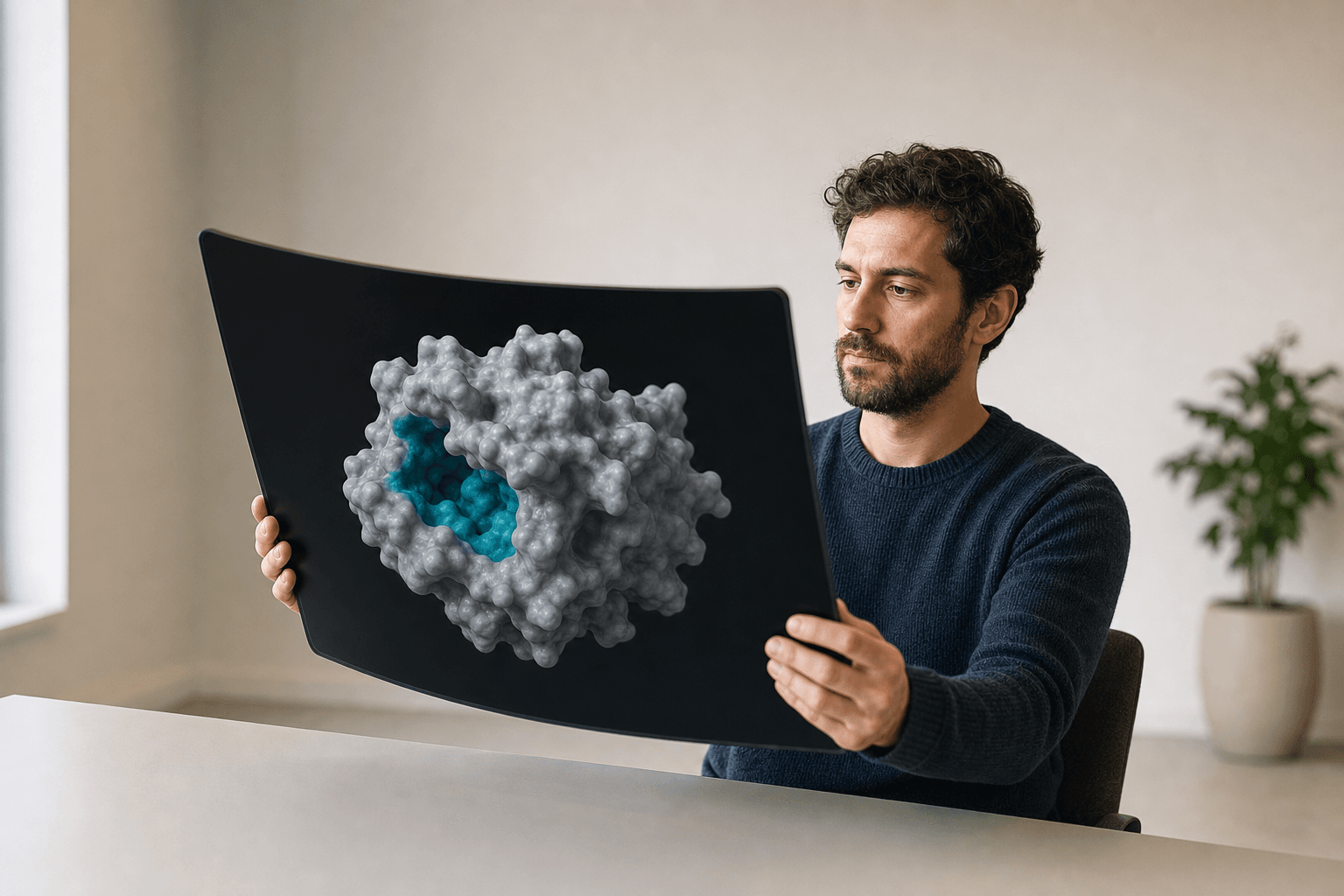 A computational chemist reviews a molecular surface structure with a binding pocket on a large curved display in a quiet office.
Immersive structure review has been possible for a decade. What Apple Vision Pro did in 2026 was move it from a demo to something a team can standardize on: standalone hardware, no tether, passthrough so people in the same room still see each other. Nanome runs on it, and on Meta Quest, Pico Neo and HTC Vive Focus 3.
The result shows up on calendars rather than in benchmarks. A weekly structure review in 3D is a scheduling decision once the hardware stops being a production.
What Nanome 2.5 added
Version 2.5 put playback and shared sessions into the same room. One live session now spans the browser web app and the headsets, so the person wearing a Vision Pro and the person on a laptop are holding the same molecule, in the same orientation, at the same second.
The browser half of that carries more weight than it sounds like. A biologist joining from a tab sees the pocket exactly as the person in the headset sees it, so the discussion runs over one shared object.
Where 2026 leaves the choice
Same shortlist, heavier inflow. The volume arriving at the review step climbed through 2026, and the number of ways a person can join that review climbed with it. Customer write-ups are at nanome.ai/case-studies.
FAQ
What changed in molecular visualization during 2026?
Four things. AlphaFold 3 co-folding turned routine while the Boltz family moved on past Boltz-2. RFdiffusion3 (beta) was open-sourced in January, all-atom and roughly 10 times faster at inference than RFdiffusion2. Apple Vision Pro made immersive review a format teams can schedule. And Nanome 2.5 brought the browser web app and the headsets into one live session.
Is Boltz-2 the best structure prediction model right now?
It is one of several. MARA runs it next to AlphaFold 3, OpenFold3, Chai-1, ESMFold and Protenix, and the Boltz family has kept moving since, with BoltzMol-1 and BoltzProt-1 arriving in June 2026. The useful habit is recording which exact model produced a given structure.
How do the main molecular visualization tools compare?
The tool-by-tool version, PyMOL through Avogadro with Nanome beside them, is in the best molecular visualization tools. That comparison holds in any year, and this page covers only what shifted during 2026.
Does immersive review still require a tethered headset?
No. Nanome runs on standalone hardware, Apple Vision Pro, Meta Quest, Pico Neo and HTC Vive Focus 3, and in a browser tab on a laptop or a Windows desktop for anyone staying at their own machine.