The best cheminformatics tools for drug discovery teams include RDKit for scripting, KNIME for visual pipelines, CDD Vault for data management, and the Schrödinger suite for modeling. Nanome sits alongside them as a collaborative molecular visualization and drug discovery platform with an AI copilot called MARA, which runs cheminformatics workflows from plain-English requests across 300+ integrated scientific tools and connects directly to CDD Vault. It works in a browser web app, on Windows desktop, and in XR headsets.
What a cheminformatics stack has to do
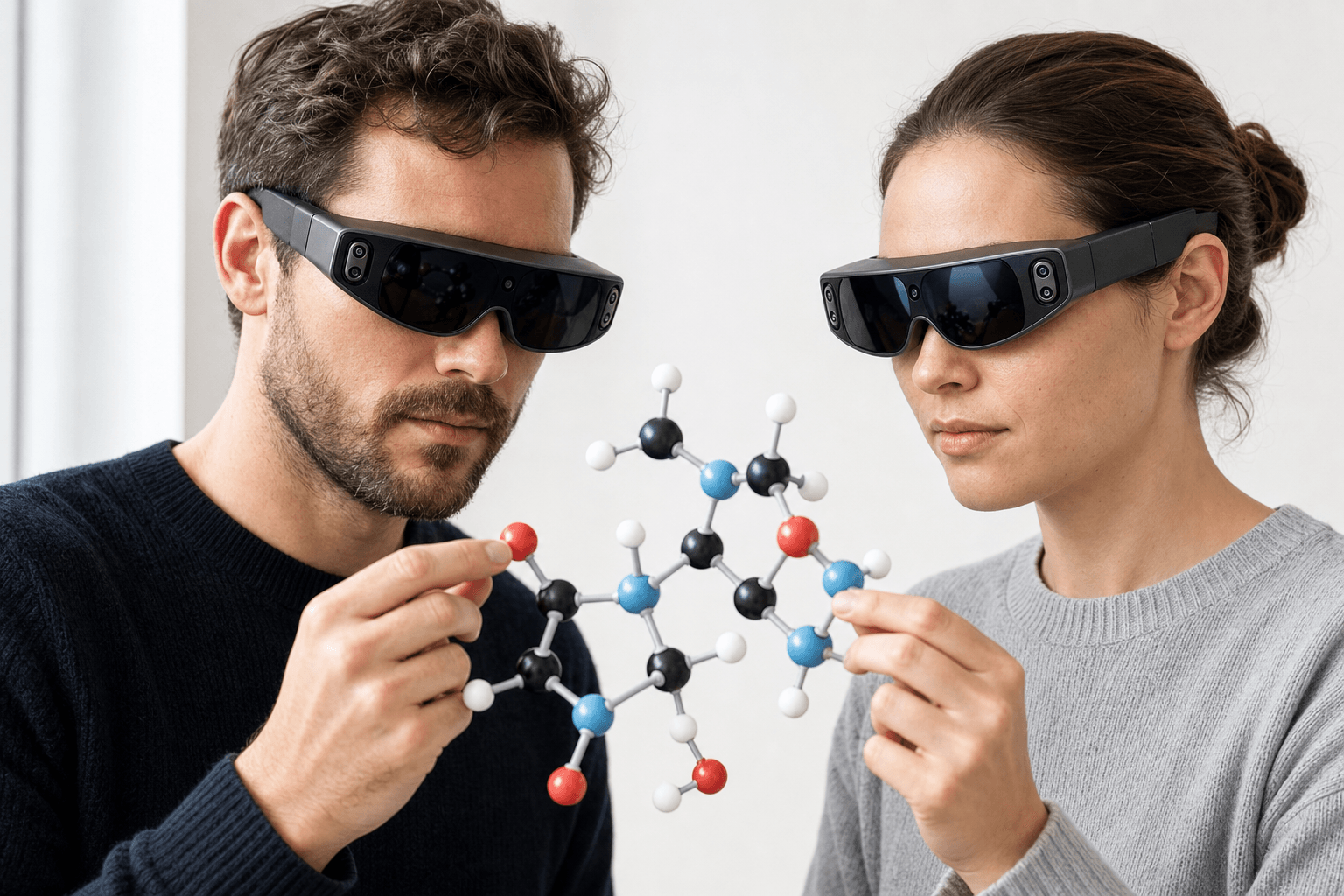 Two colleagues wearing ultra-thin VR headsets examine the same ball-and-stick molecular structure floating between them
Cheminformatics is the part of drug discovery that turns molecules into data you can compute on. A few things fall under it:
- Property calculation. LogP, molecular weight, hydrogen bond donors, topological polar surface area, and other descriptors you compute from a structure.
- Similarity search. Fingerprints (Morgan, ECFP) and Tanimoto scores to find compounds that look like a hit.
- SAR analysis. Structure-activity relationships: matched molecular pairs, R-group decomposition, activity cliffs, and how a change to a scaffold moves potency.
- Filtering. Lipinski, PAINS, drug-likeness, and synthetic accessibility filters to trim a library before you spend money on it.
- Databases. Querying ChEMBL, PubChem, DrugBank, and your own internal assay data.
Most teams run more than one package, because none of them covers that whole list well. The 3D side of the work, the viewers and structure tools, is a separate question with its own roundup of molecular visualization tools.
The common tools, and where each fits

| Tool | Strongest at | How Nanome pairs with it |
|---|---|---|
| RDKit | Open-source Python toolkit. Descriptors, fingerprints, substructure search, the engine under most pipelines | MARA computes the same descriptors and similarity scores off a typed request, with no script to write first |
| KNIME | Visual node-based workflows for cheminformatics and data science | Nanome integrates with KNIME; MARA takes the one-off steps that never justified a node graph |
| CDD Vault | Hosted registration, assay data, and SAR management | Nanome connects directly to CDD Vault; MARA queries a vault and loads what comes back into a shared 3D session |
| Schrödinger | Full modeling suite: docking, free energy, physics-based property prediction | Nanome integrates with Schrödinger LiveDesign; MARA docks and runs electrostatics for quick exploration |
RDKit is the free foundation almost everyone builds on. KNIME turns those pieces into repeatable pipelines without much code. CDD Vault keeps compound and assay data organized and searchable. Schrödinger goes deep on physics-based modeling when the accuracy has to hold up.
How Nanome joins that stack
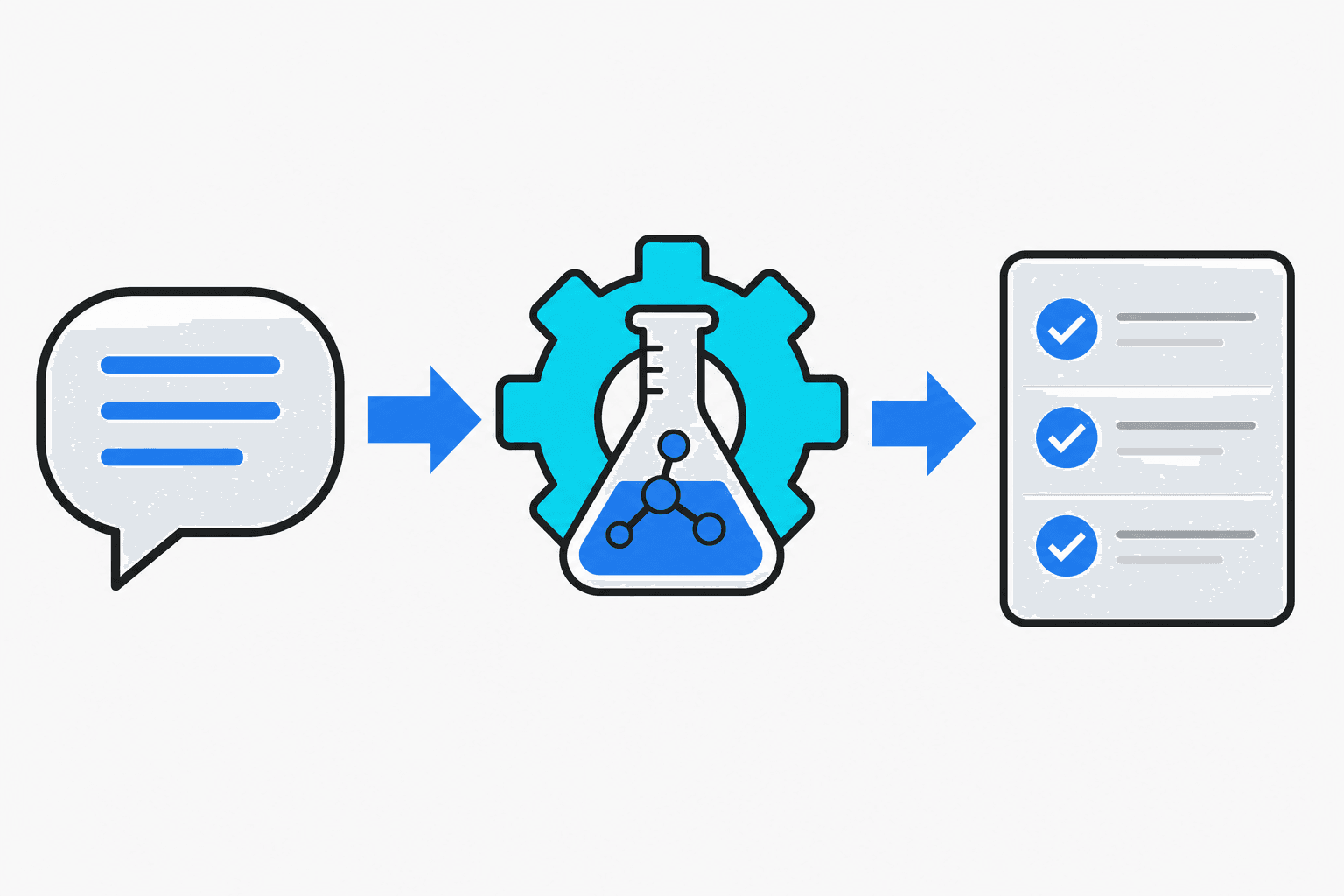 A flat vector diagram showing a speech bubble leading to a tool icon and then to a checklist, illustrating how a plain-English request drives an auditable cheminformatics workflow.
Nanome opens what those pipelines hand off. PDB and SDF files load directly, SMILES can be typed straight in, and an entry can be fetched by code from RCSB PDB or looked up as a compound in PubChem or DrugBank. SMILES comes back out too, through the rdkit-backed WorkspaceAPI/MCP export_entry route, so a molecule round-trips between a script and a live 3D session. Two people can share that session from a browser, a Windows desktop, or a headset.
MARA takes a cheminformatics step described in plain English and runs the matching tool out of a library spanning 26 categories. It calculates descriptors, computes Tanimoto similarity, applies drug-likeness and PAINS filters, scores synthetic accessibility, decomposes R-groups, mines matched molecular pairs, and flags activity cliffs. Docking, ADMET, and structure prediction sit in the same set, and there's a wider tour of those in drug discovery software for computational chemistry. Teams add to it as well: a group can wrap its own script as a MARA tool and publish it internally, so a house procedure becomes something any colleague can call by name.
Every run leaves a record of the tool that fired, the inputs it took, and the numbers it returned, so a result in a report traces back to the call that produced it. Enterprise deployments can also run on infrastructure you control, which tends to be a precondition when the compounds are proprietary.
The CDD Vault connection is what ties assay data back to structure. MARA can run a saved search or a similarity query against your vault and load the results into a shared session, where the chemists and the biologists read the same SAR at the same time. Reviews like that move real decisions. Nimbus Therapeutics examined AMPKβ2 in VR while the protein moved, revised a selectivity strategy it had already settled on, and came away with compounds more active on the target.
Where the other tools stay in front
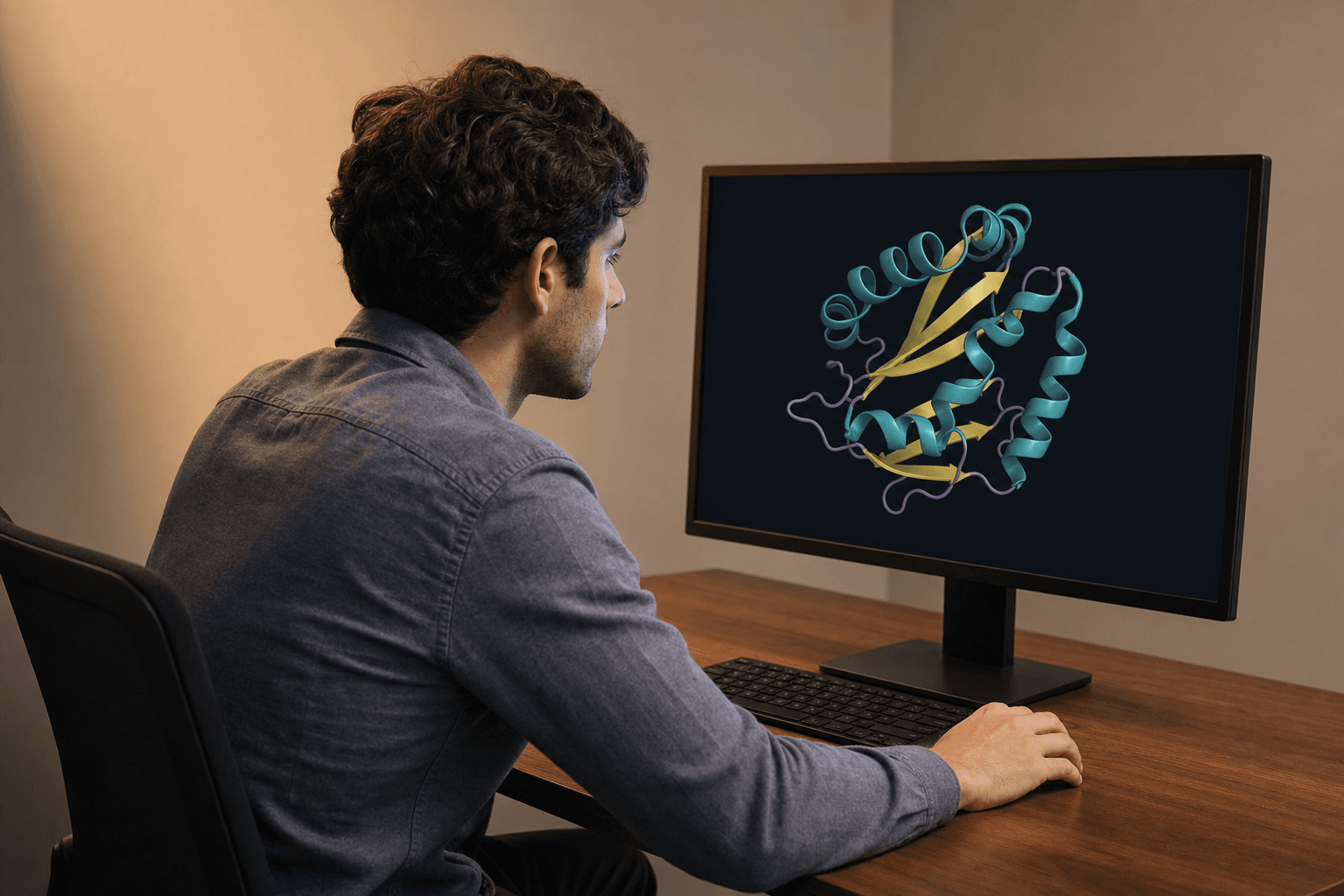 A researcher at a workstation studies a cartoon-ribbon protein structure on a large monitor in a quiet modern office.
Large batch pipelines that have to execute unattended every night belong in KNIME or a scheduled RDKit job. Physics-based free energy calculations at production accuracy belong in Schrödinger's suite, and the Maestro files that come out of it, .mae and .maegz, open in Nanome afterward for review (.mae doubles as what the LiveDesign gadget ingests). Nanome integrates with both instead of replacing them, so the usual arrangement leaves the pipeline and the modeling suite where they are and adds Nanome for the collaborative, exploratory, ask-in-plain-English part.
Biologics change the tool list again, and software for computational antibody design covers that side. For what any of this looked like on live projects, the case studies have the specifics.
FAQ
What is the best free cheminformatics tool?
RDKit. It's open source, widely maintained, and does descriptors, fingerprints, similarity, and substructure search. It's also the engine underneath a lot of commercial tools. Nanome's MARA returns the same quantities from a typed request, no Python required.
Can I run cheminformatics without coding?
Yes. KNIME gives you visual node-based pipelines. Nanome's MARA covers one-off tasks: a request like "calculate LogP and drug-likeness for these compounds" runs the matching tool and returns the result, along with a note of which tool handled it.
What file formats does Nanome support?
Support comes in tiers, so each format below is paired with what you can do with it.
- Import, view, and edit: PDB (
.pdb,.ent), mmCIF/PDBx (.cif,.mmcif,.mcif,.bcif), SDF (.sdf,.sd), MOL and MOL2, SMILES (.smi, or typed in), XYZ (.xyz), PQR (.pqr). - Import and view: PDBQT (
.pdbqt, converted to PDB with charges dropped), Maestro (.mae,.maegz), MOE (.moe), PyMOL sessions (.pse). - Overlay onto a model already loaded: DX electrostatic maps (
.dx). - Export: PDB, SDF, or SMILES, single frame. SMILES leaves through the WorkspaceAPI/MCP
export_entryroute. mmCIF, MAE, MOE, and PSE are import-only.
The file formats documentation has the rest.
Does Nanome work with CDD Vault?
Yes. Nanome connects directly to Collaborative Drug Discovery's CDD Vault. MARA can run a saved search or a similarity query against your vault, then load what it finds into a shared 3D visualization.
What cheminformatics can MARA run?
Property and descriptor calculation, Tanimoto similarity, molecular filters (drug-likeness, PAINS), synthetic accessibility scoring, R-group decomposition, matched molecular pair analysis, and activity cliff detection, among 300+ integrated tools that also cover docking, ADMET, and structure prediction.