Nanome is a collaborative molecular visualization and drug discovery platform that runs across a browser web app, XR headsets, and Windows desktop. It also ships an AI copilot called MARA. To run AlphaFold 3 or Boltz-2 inside a workflow, you ask MARA for the prediction in plain English. MARA calls the model and reports the confidence scores, then Nanome opens the predicted structure in real-time 3D or in a headset, so a sequence turns into something you can walk around without wiring two programs together yourself. Both engines sit in MARA's 300+ integrated scientific tools, and that catalogue takes additions: a group can wrap its own prediction step as a MARA tool and publish it internally, so an in-house method becomes a sentence anyone on the team can say.
The shape of a prediction-to-visualization workflow
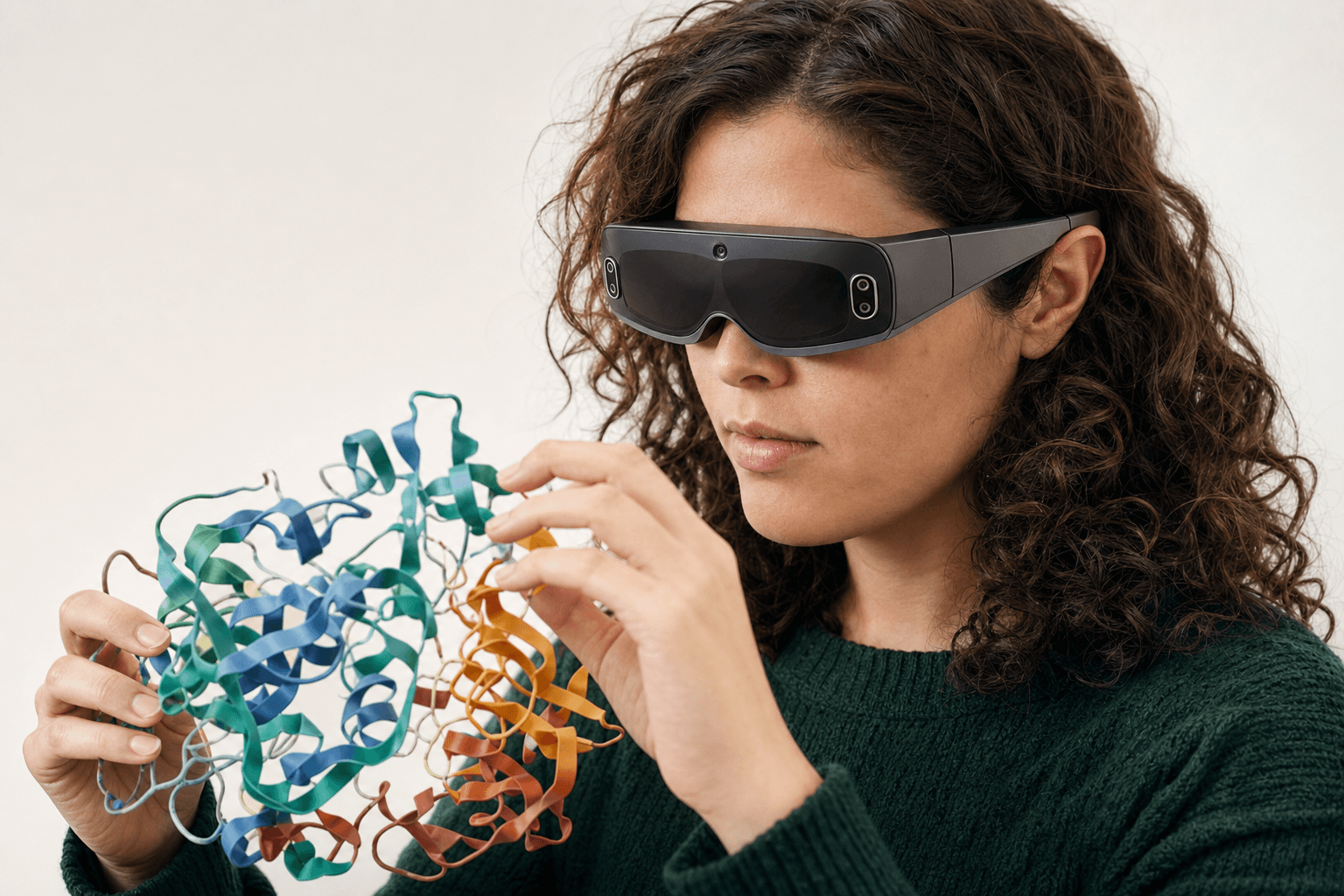 A researcher wearing an ultra-thin VR headset studies a ribbon-cartoon protein structure held close to the chest
A prediction pays off once you can grade it and then look at it. Three steps run back to back:
- Predict. Fold a sequence with AlphaFold 3, or co-fold a protein and a ligand together with Boltz-2 to get the bound complex.
- Assess confidence. Read the per-residue and per-interface scores, so the parts of the model worth acting on are marked out.
- Visualize and analyze. Open the structure in 3D or XR, color it by confidence, and run pockets, interactions or electrostatics on top of it.
Each of those steps has strong tools behind it. The cost sits in the seams between them: an export here, a format conversion there, a confidence file that lives somewhere apart from the coordinates. MARA runs the three in sequence, and each run leaves a legible trail: the tool it called, the inputs it passed, the artifact it produced. The broader shape of that orchestration, across docking and design as well as folding, gets walked through in an AI copilot for drug discovery workflows.
Step 1: predict a structure
For a plain fold, you give MARA a sequence and ask for AlphaFold 3. For a protein plus a small molecule, Boltz-2 co-folds the two and predicts how the ligand sits in the pocket, which helps when no crystal structure of the complex exists.
Boltz-2 is one engine among several here. OpenFold3, Chai-1, ESMFold and Protenix are separate calls in the same library, so a second opinion on the same sequence is one more request.
The co-folding path is written down rather than left to be reverse-engineered: Nanome's Boltz-2 tutorial walks through the configuration files and the analysis of what comes back.
Step 2: assess confidence
AlphaFold 3 and Boltz-2 both return per-residue confidence (pLDDT), and complexes come back with interface and alignment error scores on top of that.
Coloring the structure by those scores is the useful move. High-confidence regions render one way and low-confidence loops another, so the solid parts and the guesswork separate visually. MARA runs the coloring and reports the numbers next to it. When the protein-ligand interface scores badly, that surfaces before a series gets built on the pose.
Step 3: visualize and analyze in 3D and XR
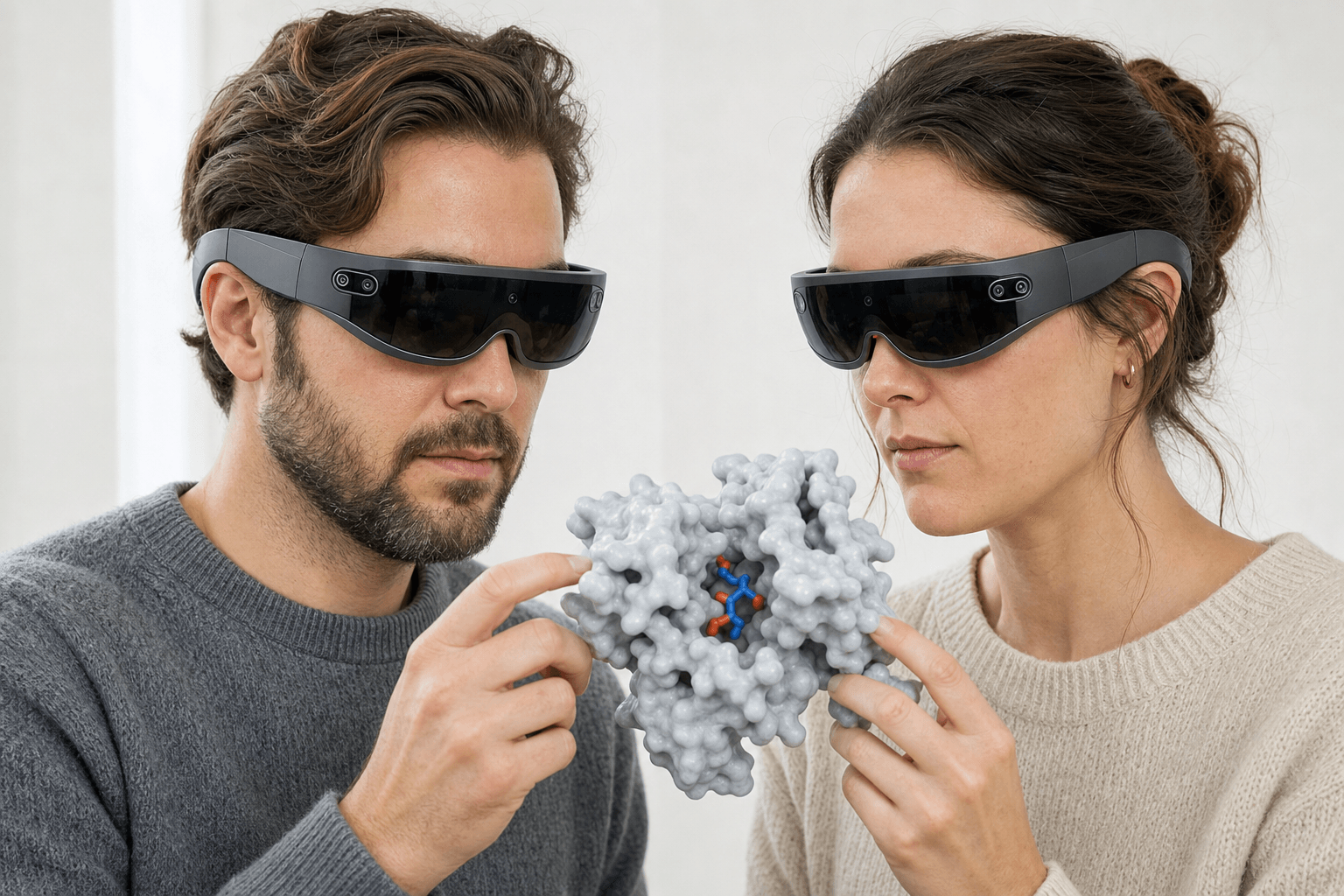 Two colleagues wearing ultra-thin VR headsets examine the same solid protein surface model with a small ligand visible in its binding pocket floating between them
With the structure predicted and scored, Nanome opens it in the workspace. You turn it over in real-time 3D in the browser, or step inside it on a Meta Quest or an Apple Vision Pro. Several people can stand in the same predicted model at once and point at the same residue, so a shaky loop gets argued about in place.
The session keeps going from there: detect pockets, map non-covalent interactions, compute electrostatics with APBS, or run ADMET on the bound ligand. The prediction feeds the analysis with no export and re-import in between. Chaining several of those calls into one longer autonomous run is a subject of its own, covered in agentic AI for computational chemistry.
The workflow at a glance
| Step | What runs | What you get | Where Nanome fits |
|---|---|---|---|
| Predict a fold | AlphaFold 3 via MARA | A predicted protein structure | Called from an ordinary sentence, then opened in the workspace |
| Co-fold a complex | Boltz-2 via MARA | Protein plus ligand, predicted bound | Configuration and analysis written up in Nanome's Boltz-2 tutorial |
| Compare engines | OpenFold3, Chai-1, ESMFold, Protenix | A second opinion on the same sequence | Separate calls in the same tool library |
| Assess confidence | pLDDT and interface scores | A graded model you can trust selectively | MARA colors the structure by confidence and reports the numbers |
| Visualize | Nanome web app and XR | The structure in real-time 3D or immersive XR | Several people in one session, on a headset or in a browser |
| Analyze | Pockets, interactions, APBS, ADMET | Downstream results on the predicted structure | Same session, no export-import between tools |
When a command line or a comp-chem suite fits better

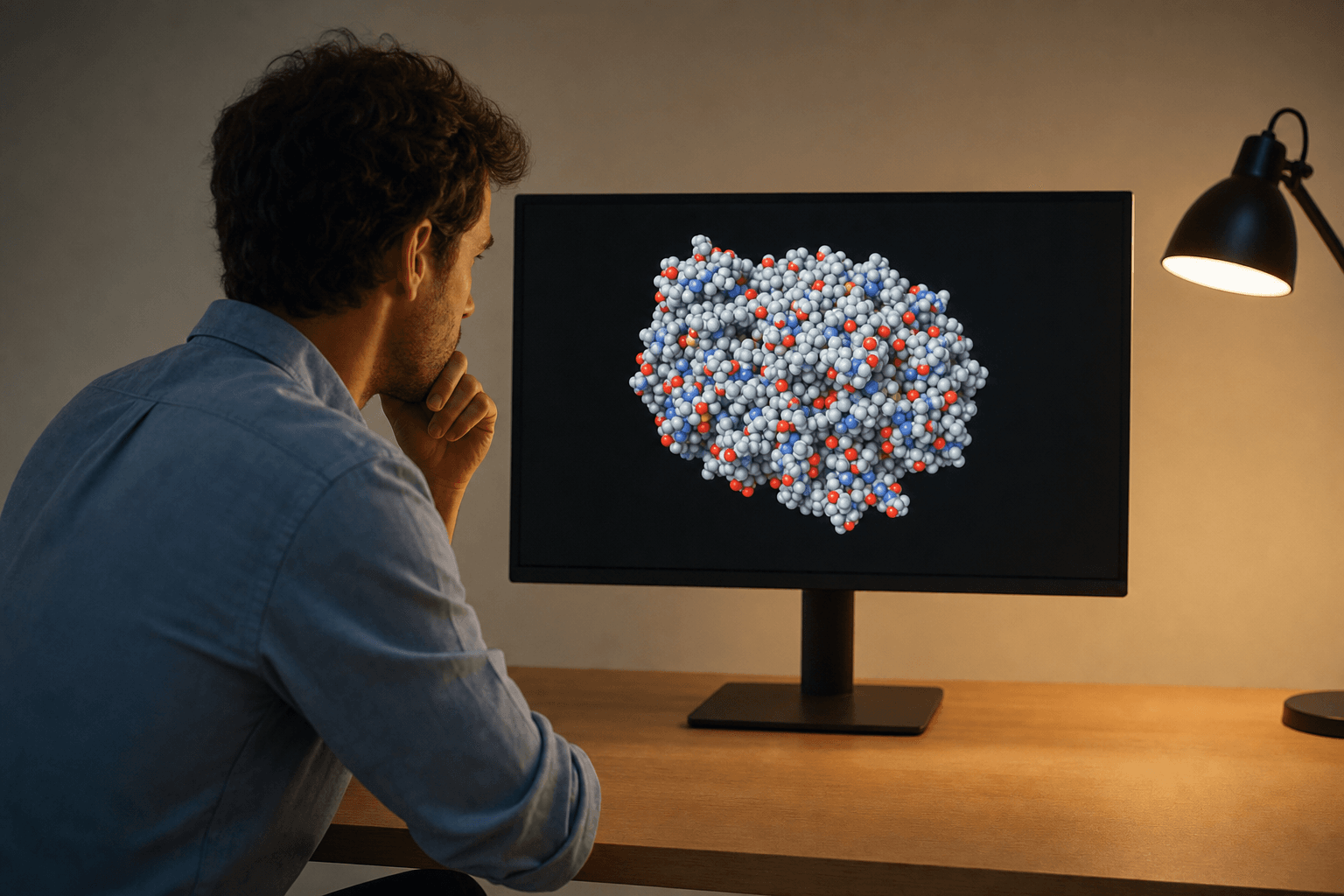 A researcher studies a space-filling protein structure on a large monitor in a quiet, uncluttered workspace.
Folding thousands of sequences as a raw batch job on a cluster, with nobody opening the results interactively, is a job for a command-line pipeline. And when a specialized prediction workflow already lives inside Schrödinger Maestro or MOE, that suite stays the right home for it. Nanome integrates with several of them, Schrödinger LiveDesign and CCG MOE included, so most groups run both. Prepared work opens for review without a rebuild: Nanome imports Maestro .mae and .maegz (the format LiveDesign ingests) and reads .moe, all of it import-only. More on supported formats.
The case for running a prediction this way is specific. The fold, the confidence read and the 3D inspection happen in one plain-English pass, and what lands at the end is a structure a whole group can stand around and argue about.
Insilico Medicine generated 10 novel SARS-CoV-2 protease inhibitors with AI, then reviewed them in Nanome in VR before committing anything to synthesis, and the work was co-authored and posted to ChemRxiv. CEO Alex Zhavoronkov put the reason for that review step plainly: medicinal chemists have to look closely at an AI-generated molecule "before placing a billion-dollar, life-or-death wager." Nanome's publications page collects the peer-reviewed work, and the customer accounts are in the case studies.
FAQ
How do I run AlphaFold 3 in a workflow?
You ask MARA for a fold in plain English and give it a sequence. MARA calls AlphaFold 3 through its integrated tools and reports the pLDDT confidence, and Nanome opens the predicted structure in the web app or in XR for inspection.
What does a Boltz-2 structure prediction workflow look like?
You point MARA at a protein and a ligand, and Boltz-2 co-folds them into a predicted bound complex. Nanome's Boltz-2 tutorial covers the configuration files and the analysis, MARA colors the output by confidence, and the structure opens in 3D or XR.
How do I predict a structure and then visualize it?
The prediction runs through MARA with AlphaFold 3 or Boltz-2, the confidence scores come back with it, and Nanome opens the result in real-time 3D or immersive XR. Pockets, interactions and electrostatics run on the predicted model in the same session.
How do I know whether a predicted structure is trustworthy?
The confidence scores answer that. AlphaFold 3 and Boltz-2 both return per-residue pLDDT, and complexes get interface and alignment error scores. MARA colors the structure by confidence, so the solid regions and the shaky ones separate before anything gets built on the model.