An AI copilot for drug discovery is an assistant that takes a plain-English request and runs the actual scientific tools behind it, then shows you exactly what it did. Nanome's copilot is called MARA. It reaches 300+ integrated scientific tools, runs them from ordinary sentences, and reports which tools fired, what inputs they got, and what came back.
That last part matters. A lot of assistants can talk about docking. MARA runs the docking, then hands you the poses.
What an AI copilot actually does
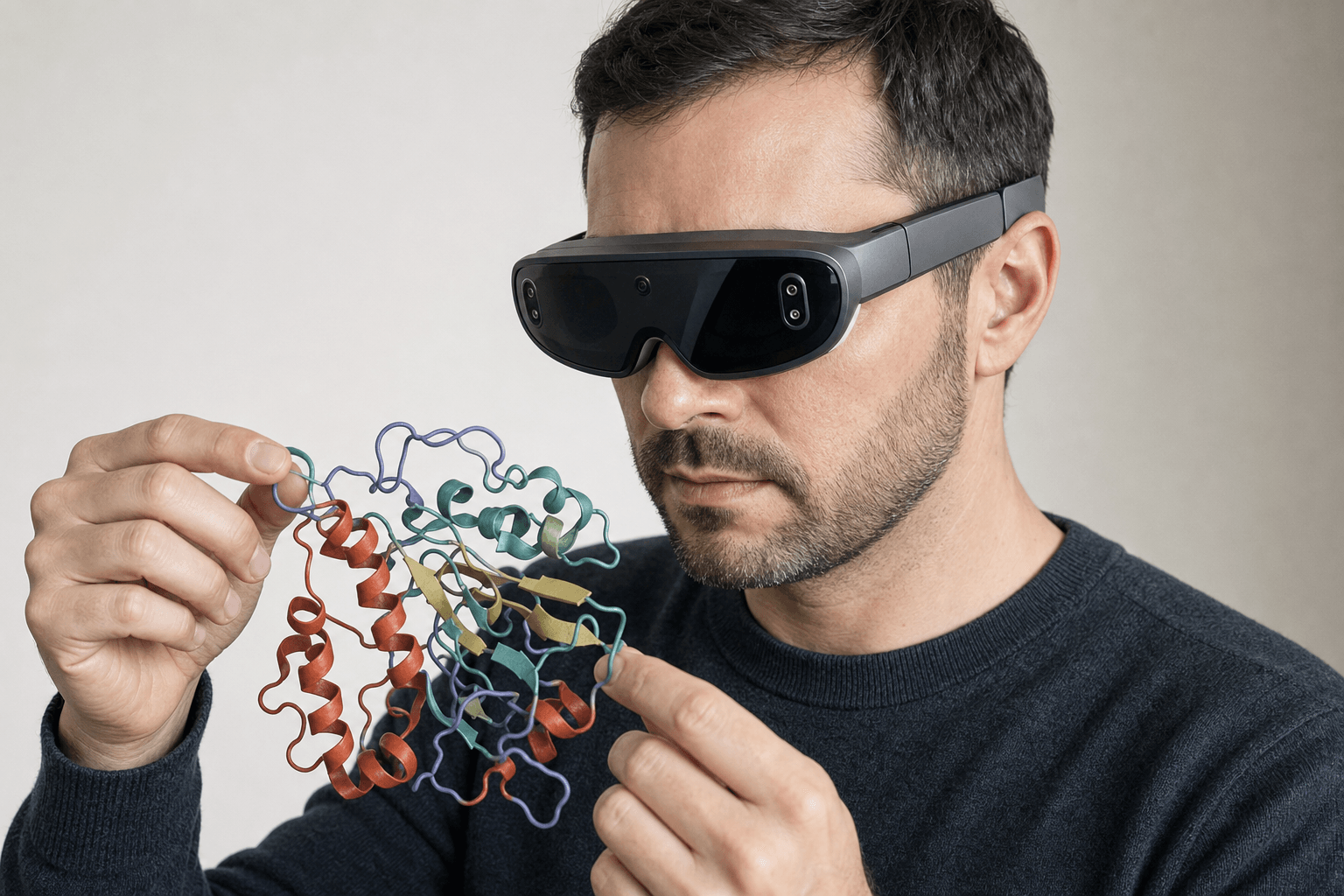 A researcher wearing an ultra-thin VR headset studies a ribbon-cartoon protein structure held close to the chest
The job is orchestration. You describe the goal, and the copilot picks the right tools, chains them in order, and returns real molecular results you can inspect in 3D.
The built-in library covers what a medicinal chemist or structural biologist works with day to day:
- Docking. Smina and DiffDock-L place a ligand in a pocket and score how well it sits.
- Co-folding. A protein and its ligand fold together, which predicts the bound complex directly.
- Structure prediction. Boltz-2, AlphaFold 3, OpenFold3, Chai-1, ESMFold and Protenix are separate calls, so running two and comparing them is a normal afternoon.
- De novo binder design. RFdiffusion3 (beta) generates candidate binders, and ProteinMPNN writes sequences onto a backbone.
- Antibody annotation. ANARCI numbers variable domains under Kabat, Chothia, IMGT or AHo and marks out the CDR loops.
- Electrostatics. APBS computes charge and potential surfaces, with PDB2PQR ahead of it for protonation.
- ADMET and toxicity. Absorption, distribution, metabolism and excretion estimates, plus eToxPred, before a molecule gets committed to synthesis.
- Cheminformatics. Property calculations and the routine bookkeeping around a series.
You ask in English. MARA translates that into a sequence of tool calls and runs them.
That library is a starting point. Groups write MARA tools of their own, wrapping an in-house method or a model the group trained, and publish them so anyone in the org can call the thing by name. Stringing those calls into a longer autonomous run has its own considerations, covered in agentic AI for computational chemistry.
A visible record of every run
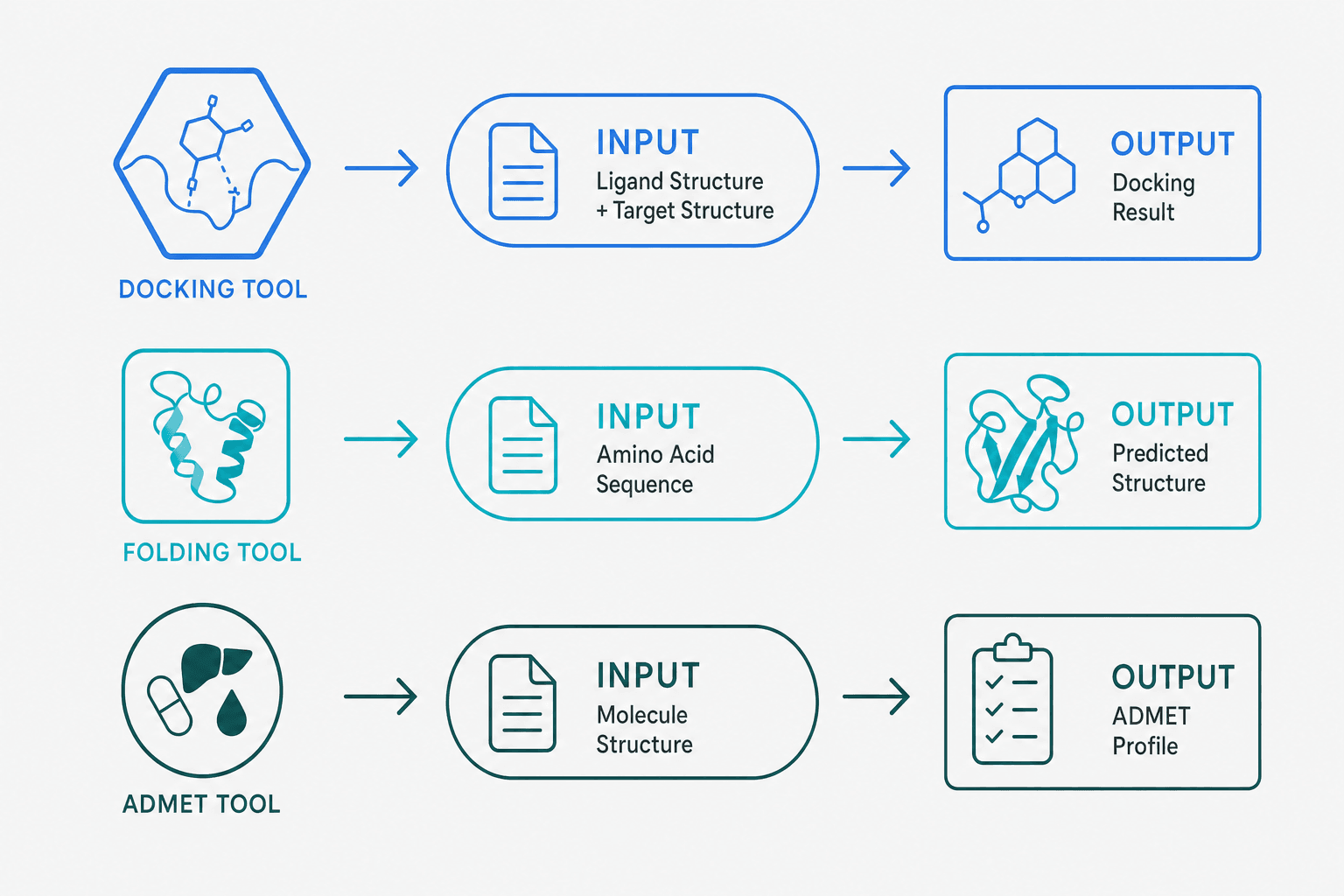 A flat vector diagram showing three scientific tools each connected to their inputs and outputs in a transparent, auditable chain.
A copilot is worth pointing at real science when its work is auditable. MARA names the tool it called, the inputs it passed, and the artifact it produced, and every one of those is something a scientist can open.
When it reports a docking score, the pose, the parameters and the source structure come with it. When it predicts a fold, the report says whether Boltz-2 or AlphaFold 3 produced the answer. Both are results a chemist can pull apart before acting on them.
That review step is the whole argument for a copilot over a chatbot. Insilico Medicine generated 10 novel SARS-CoV-2 protease inhibitors with AI, then brought them into Nanome in VR for the medicinal chemistry review. The work was co-authored and posted to ChemRxiv. Their CEO put the reasoning plainly:
"While AI can come up with novel and diverse drug-like molecules, it is important for medicinal chemists to look at these molecules closely before placing a billion-dollar, life-or-death wager. VR enables medicinal chemists to do this."
Alex Zhavoronkov, CEO, Insilico Medicine
Deployment behind your firewall
Drug discovery data is sensitive, so MARA and Nanome's enterprise deployments run behind your firewall, as a single-tenant cloud instance or entirely on-prem. Structures and sequences stay in the environment they started in.
That is what lets teams at Genentech and Novartis point a copilot at proprietary chemistry without shipping it to a shared service. The peer-reviewed record sits in Nanome's publications.
300+ tools, an open API, and MCP servers
MARA connects to 300+ scientific tools across 26 categories. Nanome also ships an open REST API plus MCP servers, so the copilot can be driven from the pipeline you already run, or drive it.
Structures come in from RCSB PDB, PubChem and DrugBank without a download step, and Nanome reads PDB, SDF, mmCIF, MOL/MOL2, PQR, XYZ and SMILES. More on supported formats.
It sits next to suites teams already own: CDD Vault and KNIME on the data side, Schrödinger LiveDesign, Cresset Flare and OpenEye (Cadence) on the modeling side, plus OpenFold and Jupyter. A Nanome Claude Code Skill is available too, so an outside agent stack can call Nanome tools directly. There's a fuller walkthrough in MCP servers for cheminformatics and drug discovery.
How MARA differs from a general chat assistant
| Capability | Generic chat assistant | Nanome MARA |
|---|---|---|
| Answer questions about docking or folding | Yes | Yes |
| Actually run docking, co-folding, ADMET | No | Yes, 300+ tools |
| Name the tool it called and the inputs it used | No | Yes, full trace |
| Return inspectable 3D molecular results | No | Yes, in the web app and XR |
| Run behind your firewall on your data | Rarely | Yes, single-tenant or on-prem |
| Plug into your pipeline via API and MCP | Limited | Yes, open REST API plus MCP servers |
A general assistant can describe a method well. MARA runs it and leaves you the files.
Where a different tool fits better

For a scriptable desktop viewer under one person's control, PyMOL and UCSF ChimeraX are excellent and heavily documented. Nanome opens PyMOL .pse session files for viewing, and it parses the standard structure files ChimeraX handles.
When a specialized workflow lives inside a full comp-chem suite like Schrödinger Maestro or MOE, that suite stays the right home for it. Nanome imports Maestro .mae and .maegz (the format LiveDesign ingests) plus .moe, so prepared work opens in a shared 3D session without a rebuild. More on supported formats. Several of those suites are Nanome integrations, so most groups run both.
A copilot pays off when the work crosses many tools, when the record of what ran has to be legible to a colleague who wasn't there, and when the people judging the result want to stand around the same molecule in a browser or a headset. The customer proof for all of that sits in the case studies.
FAQ
What is an AI copilot for drug discovery workflows?
An assistant that turns a plain-English request into real tool runs across docking, folding, ADMET and design work, then shows what came back. Nanome's copilot, MARA, orchestrates 300+ scientific tools spread across 26 categories.
What scientific tools can MARA run?
Structure prediction and co-folding (AlphaFold 3, Boltz-2, OpenFold3, Chai-1, ESMFold, Protenix), docking (Smina, DiffDock-L), de novo design (RFdiffusion3, ProteinMPNN), antibody numbering and CDR definition (ANARCI), electrostatics (APBS, PDB2PQR), toxicity and ADMET estimates (eToxPred, ToxinPred), and cheminformatics property work.
Can these AI-powered molecular analysis tools run on private data?
Yes. Enterprise deployments of Nanome and MARA sit inside your own network, either as a single-tenant cloud instance or fully on-premises, so nothing proprietary leaves the building.
How does MARA fit into an existing pipeline?
Through the REST API, the MCP servers, and direct integrations with CDD Vault, KNIME, Jupyter, Schrödinger LiveDesign, Cresset Flare and OpenEye (Cadence). A Nanome Claude Code Skill is available for teams driving Nanome from their own agents.