MOE (Molecular Operating Environment), from Chemical Computing Group, is an integrated computational chemistry suite, strong in medicinal chemistry, protein modeling, and antibody work, run through a desktop interface. Nanome is a collaborative molecular visualization and drug discovery platform that spans a browser web app, XR headsets, and Windows desktop. Inside it, an AI copilot called MARA runs the computational work. If you're looking at alternatives to MOE, the two cover different parts of the problem, and Nanome often sits alongside a suite like MOE rather than replacing it. CCG MOE is a listed integration on nanome.ai, so this is a pairing as much as a choice.
Both tools read the same structure files. The difference shows up in what happens once a file is open.
What MOE does well


MOE is a mature, single-package environment for structure-based and ligand-based design. The draw is that the whole pipeline sits in one window: protein preparation, docking, pharmacophore work, QSAR, and antibody modeling, with SVL scripting to automate any of it.
The antibody side is the part worth naming. MOE has a long track record across medicinal chemistry and biologics, and a lot of published work runs through it. A group fluent in SVL, with its workflows already built around the suite, has a real reason to stay put.
Where Nanome is different
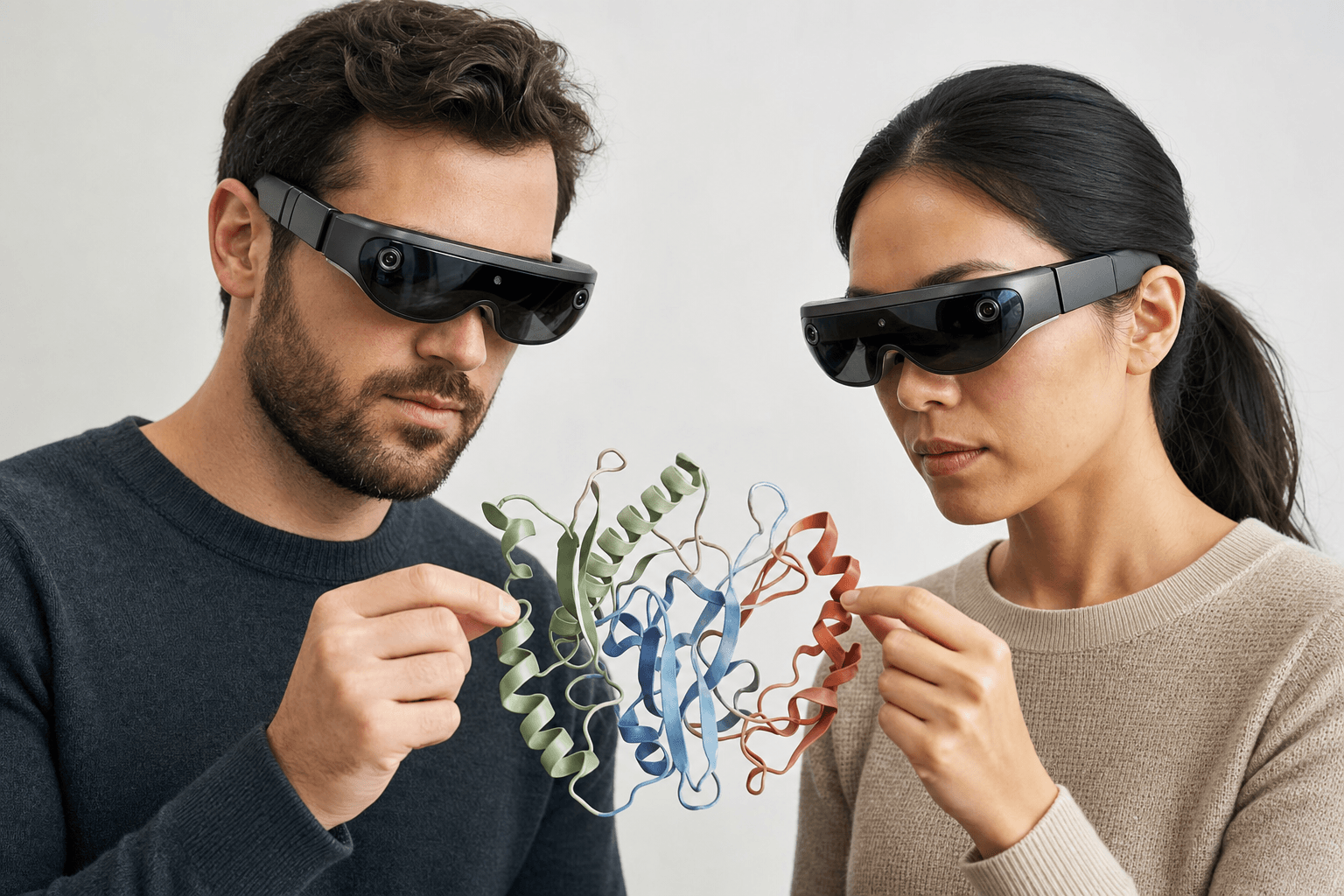 Two colleagues wearing ultra-thin VR headsets examine the same ribbon-cartoon protein structure floating between them
Nanome covers ground a desktop suite doesn't aim at.
Real-time multiplayer. Several people stand inside the same structure at once and point at the same atoms. Everyone holds the model, so a colleague can swing the ligand around while you watch the pocket from the far side.
Native XR. Nanome runs in immersive 3D on Apple Vision Pro, Meta Quest, HTC Vive Focus 3, and Pico Neo, and on Windows desktop or in a browser for anyone without a headset. You walk around a binding pocket at hand scale instead of rotating it on a flat monitor.
An AI copilot (MARA). Ask in plain English and MARA runs the job across 300+ integrated scientific tools: docking with Smina and DiffDock-L, electrostatics through APBS, ADMET and toxicity prediction, sequence-to-structure folding with AlphaFold 3 and Boltz-2, and de novo binder design with RFdiffusion3 (beta). Each run reports the tool that did the work, the inputs it took, and what it returned, so the result can be checked rather than taken on faith.
Antibody tooling, specifically. Since antibody modeling is MOE's strongest suit, that comparison deserves detail. ProteinMPNN designs new sequences for a given backbone, and ANARCI numbers a variable domain and defines its CDR loops under the Kabat, Chothia, IMGT, and AHo schemes. One project reviewed this way is antibody prophylaxis for Lyme disease, where the antibody is meant to block infection before it takes hold and the binding interface was examined in immersive 3D.
Side by side
| Package | Where it's strong | How the pair works |
|---|---|---|
| MOE | One desktop suite for medicinal chemistry: protein prep, docking, pharmacophore and QSAR work, antibody modeling, all scriptable in SVL | Nanome imports .moe files, so a structure prepared in MOE opens in a shared session without a conversion step |
| Nanome | Multi-user visualization in a browser and in headsets, with MARA reaching 300+ tools including ProteinMPNN and ANARCI | MARA covers docking, folding, electrostatics, and antibody numbering from a plain-English request |
When MOE is the right pick
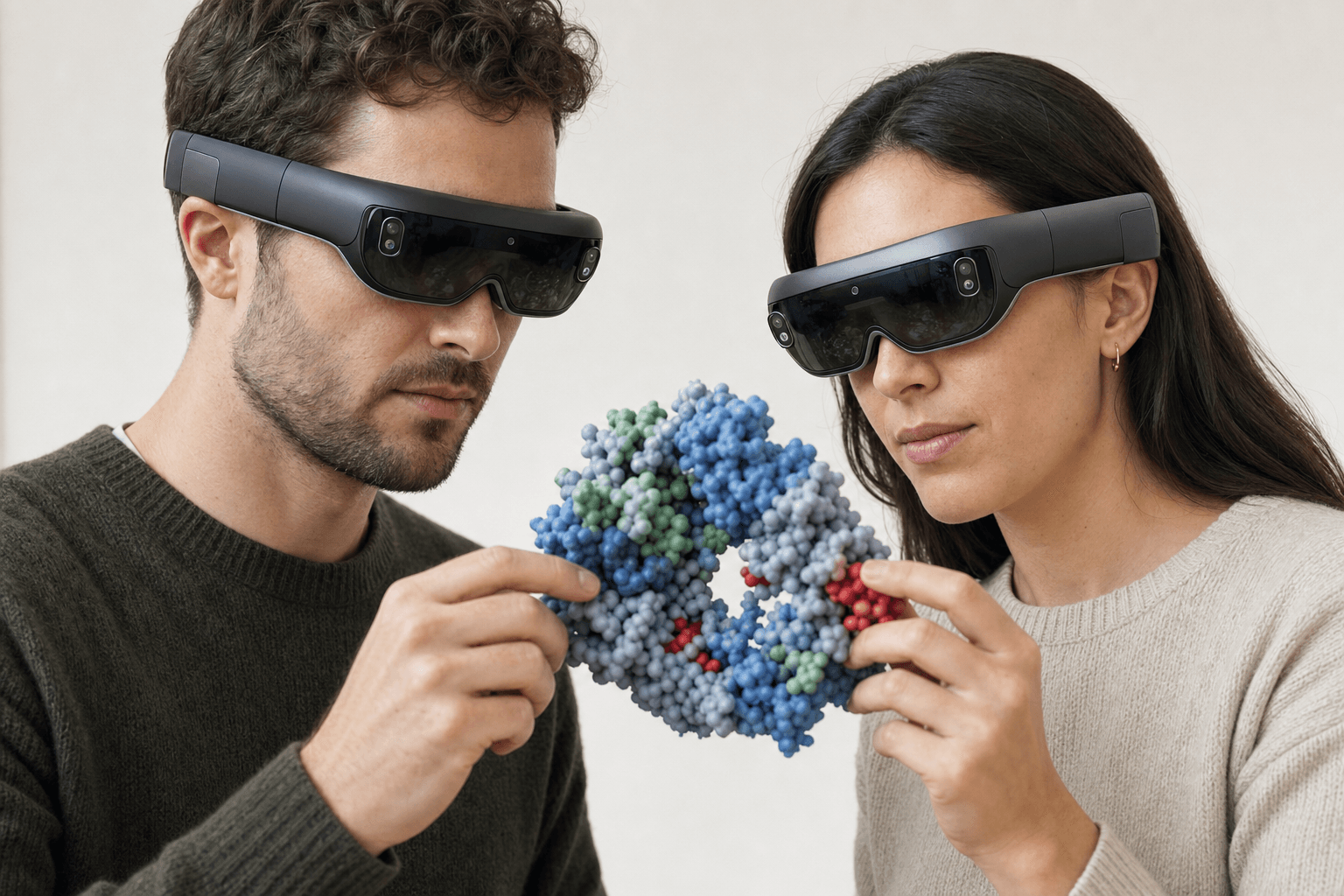 Two colleagues wearing ultra-thin VR headsets examine the same space-filling protein model floating between them
A team that wants one desktop suite with a deep, established medicinal chemistry and antibody pipeline, staffed by people fluent in SVL, is well served by MOE. It's respected for good reasons.
Nanome fits when the work is collaborative, when seeing a structure at hand scale changes what someone notices about a pocket, or when you'd rather ask for docking, folding, and antibody annotation than write the script. Plenty of groups keep a suite like MOE for the heavy modeling and bring the structures into Nanome for the shared review.
If that modeling ends in molecular dynamics, the trajectory can come along. Nanome loads and plays back MD trajectories. A .gro file loads on its own; .xtc, .trr, and .dcd attach to a model already in the workspace and have to match its atom count. Frame-trajectory playback carries a 2000-frame cap, and surfaces switch off while a trajectory plays. More on supported formats.
Two neighboring comparisons cover the rest of this category: the PyMOL post for the desktop viewer side, and the BIOVIA Discovery Studio post for the other broad commercial package.
Structures arrive from PubChem, DrugBank, ChEMBL, UniProt, and the RCSB PDB without a separate download, and an open REST API plus MCP servers let a script or an agent drive the workspace directly. Nanome's case studies collect the customer project write-ups.
FAQ
What are the alternatives to MOE?
Full desktop comp-chem suites like Schrödinger Maestro and BIOVIA Discovery Studio cover similar ground to MOE. Nanome comes at the same structures from a different angle, with multi-user visualization on the web and in XR and MARA driving the computational tools, so teams more often pair it with a suite than swap one out. Files move either way: Nanome imports Maestro .mae and .maegz (the LiveDesign ingestion format) alongside PDB and mmCIF coordinates, SDF and MOL2 ligands, plus XYZ and PQR.
What file formats does Nanome support?
Structures: PDB (.pdb, .ent), mmCIF (.cif, .mmcif, .bcif), SDF (.sdf, .sd), MOL and MOL2, SMILES, XYZ, PQR, and PDBQT. Vendor and session files are import-only: Maestro .mae and .maegz, MOE .moe, and PyMOL .pse. MD trajectories: a .gro file stands alone, while .xtc, .trr, and .dcd attach to a model that is already loaded and must match its atom count. Electrostatic maps attach as .dx overlays. Export is PDB, SDF, or SMILES, one frame at a time. More on supported formats.
Is Nanome a Molecular Operating Environment alternative for antibody work?
In part. ProteinMPNN designs sequences, ANARCI numbers variable domains and defines CDR loops, and the Lyme prophylaxis project shows what the shared 3D review adds on top. MOE remains a strong dedicated choice for antibody modeling, which is why a lot of groups run both.
Can I use MOE and Nanome together?
Yes. CCG MOE is a listed integration on nanome.ai. Nanome imports .moe files directly, so a structure prepared in MOE opens in a shared XR session, and MARA can then dock it, fold a partner, or run electrostatics on it. An open REST API and MCP servers cover the scripted path.
Does Nanome need a headset?
No. It runs in a browser web app and on Windows desktop. XR is there when immersive 3D helps, on Meta Quest, Apple Vision Pro, HTC Vive Focus 3, or Pico Neo.