Nanome is a collaborative molecular visualization and drug discovery platform that runs in a browser web app and on XR headsets. Inside it sits MARA, an AI copilot. With MARA, you type or speak a request in plain English ("dock this ligand into the pocket," "predict ADMET for these 12 compounds"), and it picks the right tool, runs it, and shows you exactly what ran, what went in, and what came out. The structures load and light up in 3D, on your desktop or inside a headset.
That's the shift. For decades, molecular modeling meant memorizing menus, chaining scripts, and knowing which flag did what. MARA lets you describe the outcome you want and handles the plumbing underneath.
How a plain-English request becomes a real tool run
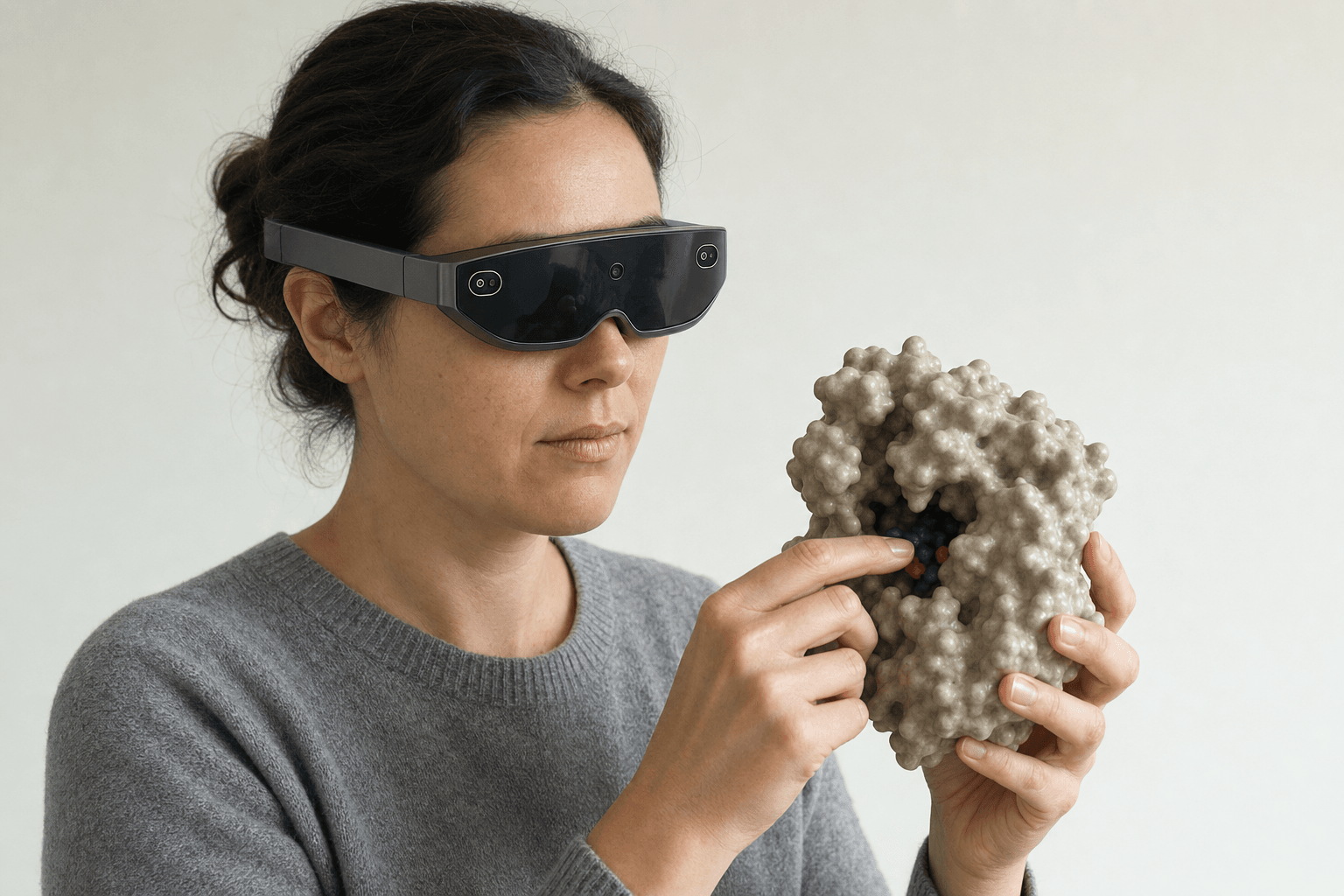 A researcher wearing an ultra-thin VR headset studies a solid protein surface model with a visible binding pocket held close to the chest
MARA sits on top of 300+ integrated scientific tools across 26 categories. A request maps onto one of those tools, picks up inputs from whatever structures are open, and runs the actual computation. Docking really docks. Prediction really predicts.
The part that matters for trust: MARA shows its work. Every run lists the tool it called, the exact inputs, and the raw outputs. Docking scores, binding residues, confidence values, all of it is there to check. Nothing hides behind a chat bubble. How the copilot is put together underneath is a subject of its own, covered in an AI copilot for drug discovery workflows.
Then the result goes to the viewer. A docked pose, a predicted fold, an electrostatics surface: all of it renders in the same 3D workspace you can walk around in XR or spin in a browser tab.
Example requests and the tools they trigger
| You type or say | What MARA runs | What you get back |
|---|---|---|
| "Dock this ligand into the ATP pocket" | Smina or DiffDock-L docking | Scored poses in the pocket, viewable in 3D |
| "Co-fold this peptide with the receptor" | Boltz-2 / AlphaFold 3 co-folding | A predicted complex with confidence coloring |
| "Predict ADMET for these compounds" | ADMET prediction | Property tables per molecule |
| "Show the electrostatic surface" | APBS electrostatics | A colored potential map on the protein surface |
| "Design 20 binders for this epitope" | RFdiffusion3 (beta) de novo binder design | Candidate backbones ready to inspect |
| "Number the CDR loops on this antibody" | ANARCI numbering and CDR definition | Annotated antibody regions |
| "Set up 4 scenes showing each pose from the same angle" | Scene creation in the workspace | Four saved 3D views, each holding its own camera |
| "Make a slide from this scene" | PowerPoint slide generation | A slide built from the live structure |
The last two rows cover what happens after the run. Scenes are saved 3D views of the same structure, each with its own angle, and a colleague can step through them on the web or in a headset, which is roughly what a modern molecular presentation looks like.
Starting structures come from RCSB PDB, PubChem, or DrugBank, or from files you already have. From there the request is just a sentence.
The catalogue grows from your side too. Teams write their own MARA tools and publish them to colleagues, so an in-house method becomes a sentence anyone in the group can say. Stringing several of those runs into one instruction is where this turns agentic.
How this sits alongside established modeling software


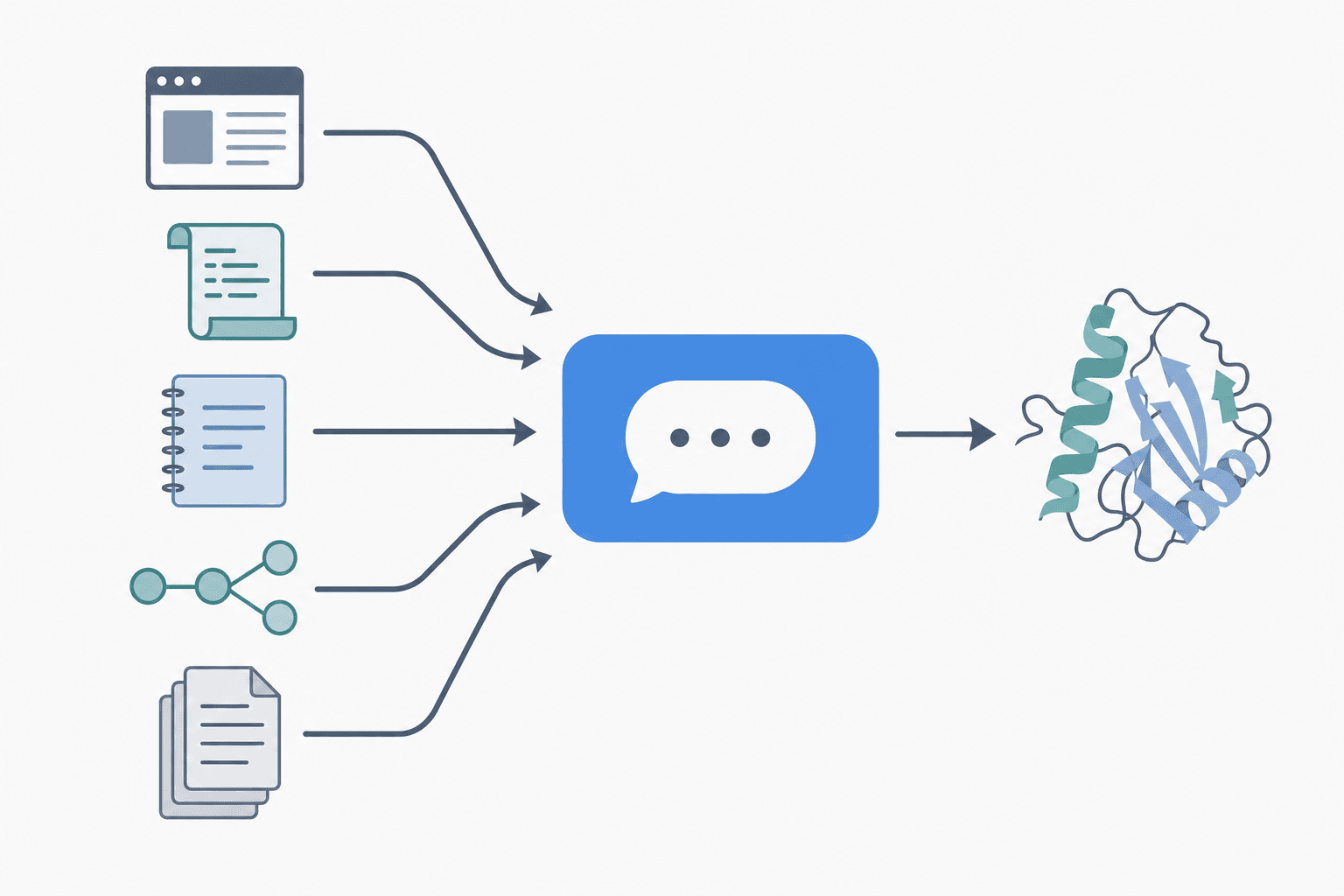 A flat diagram showing multiple specialist tool icons converging through a single interface into one unified molecular result.
Plenty of software does molecular modeling well, and most of it is driven through a GUI or a scripting layer. A typed or spoken sentence is a third way in.
| Software | Its strength | What Nanome adds |
|---|---|---|
| PyMOL, ChimeraX, VMD | Precise desktop viewing and scripting | Spoken or typed tool runs, plus multiplayer 3D and XR over the same structures |
| Schrödinger Maestro, MOE, Discovery Studio | Deep desktop comp-chem suites | MARA runs many of the same analyses from a typed request, and Nanome integrates with several of these suites rather than replacing them |
| Notebook-driven pipelines (KNIME, Jupyter) | Reproducible scripted workflows | An API and MCP servers, so a request and a pipeline work on the same structures |
The handoff happens at the file level. Nanome reads PyMOL .pse sessions, Maestro .mae and .maegz (the format LiveDesign ingests), and MOE .moe, all of them import-only. Structures arrive as PDB, mmCIF, SDF, MOL and MOL2, XYZ, PQR, or PDBQT, and export is PDB, SDF, or SMILES, one frame at a time. The full tiers per format sit in the supported formats docs.
Nanome connects outward as well: CDD Vault, Schrödinger LiveDesign, CCG MOE, OpenEye/Cadence, Cresset Flare, the OpenFold Consortium, plus KNIME and Jupyter.
A plain-English layer buys less when a group already scripts one desktop suite fluently and spends the whole day inside it. It pays off when the work crosses many tools, when colleagues need to stand in the same 3D scene, or when picking the tool is itself the slow step.
Where the 3D and the people come in
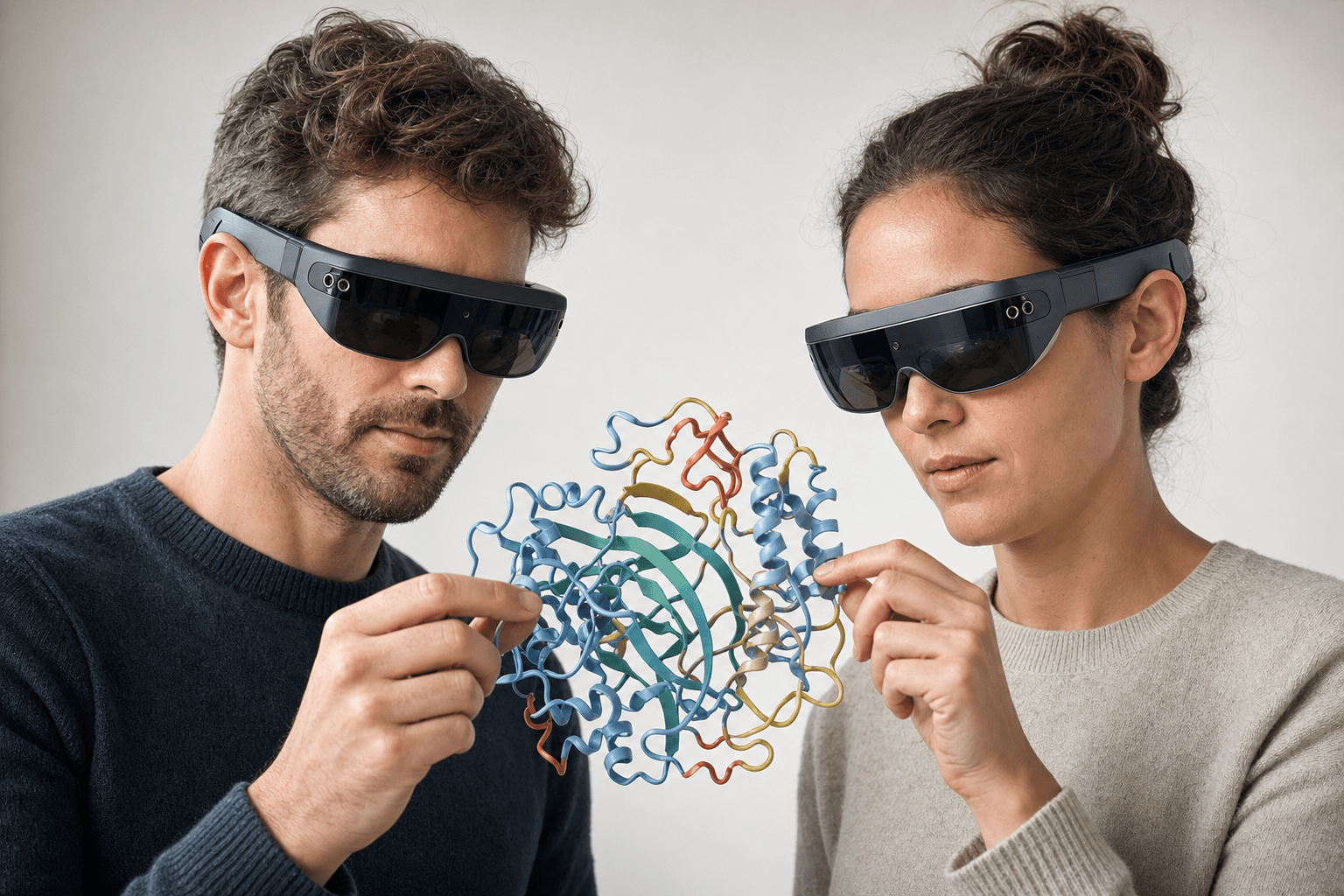 Two colleagues wearing ultra-thin VR headsets examine the same ribbon-cartoon protein structure floating between them
Reading a docking score is one thing. Standing next to the pocket with a colleague and watching the pose settle is another.
The same session opens on Windows desktop, in a browser tab, or in a headset: Meta Quest, Apple Vision Pro, HTC Vive Focus 3, Pico Neo. Several people can hold one molecular scene between them at once, so a MARA result becomes something the whole group can walk around at full size.
In a headset there's no keyboard within reach. You can say the request to MARA instead and keep both hands on the molecule while it runs.
Prof. Radić's group at UC San Diego described the loop plainly: "We use minimization... we can dock it to a macromolecule using Smina Docking... we can form covalent conjugates, we can minimize, dock it and score it in real time." Smina is still one of the docking engines a typed request reaches. More stories at nanome.ai/case-studies.
FAQ
What is natural language molecular modeling?
Describing a modeling task in ordinary words and letting software pick and run the right computational tool. With Nanome's MARA, "dock this ligand" or "predict the fold" triggers the real docking or structure-prediction run, then shows the inputs and the outputs.
Can I really talk to my molecular data?
Yes. You load a structure from RCSB PDB, PubChem, DrugBank, or your own files, then type or say what you want done. MARA maps the request onto one of 300+ tools and runs it, with the results rendered in 3D.
Are these plain-English drug discovery tools accurate, or just chat?
The tools are the real thing: Smina and DiffDock-L docking, Boltz-2 and AlphaFold 3 co-folding, APBS electrostatics, ADMET prediction, ANARCI antibody numbering, RFdiffusion3 (beta) binder design, and cheminformatics. MARA reports the tool that ran, the exact inputs, and the raw outputs, so any result can be checked line by line.
Do I need a VR headset?
No. Nanome opens in a browser tab and on Windows desktop. Headsets add shared immersive 3D (Meta Quest, Apple Vision Pro, HTC Vive Focus 3, Pico Neo) and stay optional.
Where do my structures go when MARA runs a tool?
For regulated work, Nanome deploys inside your own network, as a single-tenant cloud or on-prem, so structures and results stay in an environment your team controls.