The best molecular modeling software depends on what you're modeling and how you want to touch it. Nanome is a collaborative platform where you build, edit, and minimize molecular structures in 3D across a web app and XR headsets. Inside it, an AI copilot called MARA handles the simulation-adjacent work: minimization, conformer generation, and docking. For classic desktop building and editing there's Avogadro, and for full comp-chem suites there's MOE, Schrödinger, and BIOVIA Discovery Studio.
Molecular modeling is a wide category. It covers building a structure atom by atom, editing bonds and geometry, minimizing energy to reach a sensible conformation, and running the physics that predicts how a molecule behaves. A given project usually needs one or two of those and rarely all four, so the right pick tracks the specific job.
What to look for
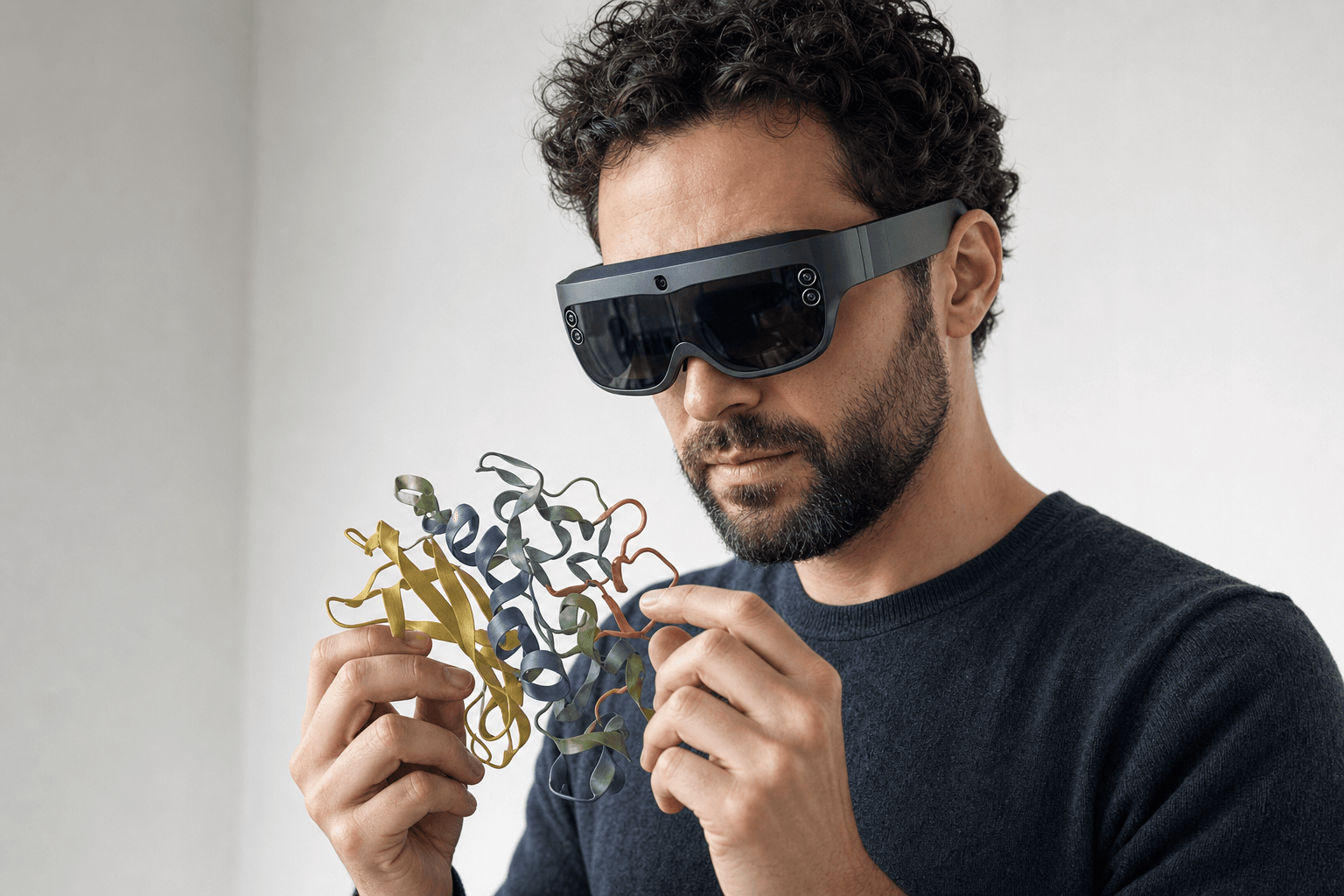 A researcher wearing an ultra-thin VR headset studies a ribbon-cartoon protein structure held close to the chest
The task comes first. Sketching a small molecule, cleaning up a protein, generating conformers, and setting up a docking run pull in different directions, and few packages are the strongest option for all four.
Inputs come next. Modeling software that reads PDB for proteins and SDF for small molecules, and fetches structures straight out of RCSB PDB and PubChem, takes a conversion step off the front of the job.
Then there's how the structure gets handled once it's open. A mouse and a flat panel are fine for 2D sketching. Fitting a ligand into a binding pocket is a judgment about depth and clearance, and depth is the first thing a flat projection throws away.
Where each tool fits
| Software | Its strength | How Nanome pairs with it |
|---|---|---|
| Avogadro | Free desktop builder and editor for small molecules, with force-field minimization | Nanome runs the same build-and-minimize loop at arm's length in 3D, with several people in the workspace at once. It imports the ordinary structure files: PDB, mmCIF, SDF, MOL2, XYZ and PQR, plus PDBQT since 2.6.0. |
| MOE (Molecular Operating Environment) | Full comp-chem suite: modeling, docking, protein prep, cheminformatics | CCG MOE is a listed Nanome integration, so the two sit in one chain. Nanome opens .moe files for viewing, and there's no .moe writer going back. |
| Schrödinger (Maestro, LiveDesign) | Physics-based modeling and simulation at scale | Nanome connects to LiveDesign and opens Maestro .mae and .maegz, the format LiveDesign hands structures off in. The heavy compute stays in Schrödinger. |
| BIOVIA Discovery Studio | Broad life-science modeling and simulation environment | Nanome sits beside the suite as the hands-on 3D layer for building and minimizing, and takes the same structure files the suite already writes. |
Traffic the other way is narrower. Nanome writes PDB, SDF or SMILES, one frame at a time, which leaves mmCIF, MAE and MOE as import-only. More on supported formats.
What Nanome does
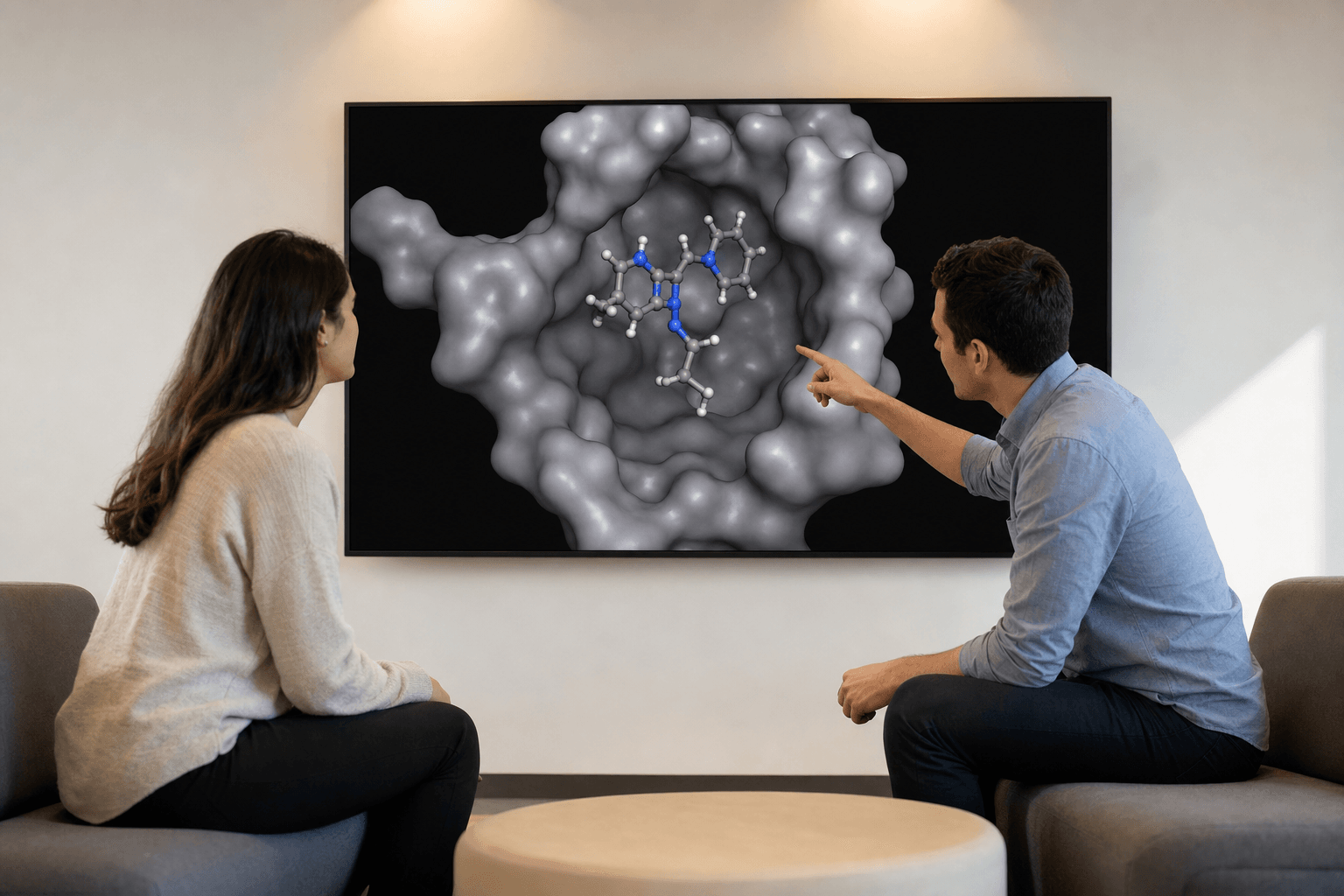 Two colleagues review a ligand docked into a protein binding pocket on a large wall display in a modern lounge.
You build and edit at close to hand scale. Grab an atom, change a bond, adjust a torsion, then run a minimization and let the geometry settle.
Headsets covered: Meta Quest, Apple Vision Pro, HTC Vive Focus 3, and Pico Neo. There's a Windows desktop build as well, and a browser app that asks for nothing beyond a laptop.
Structures arrive from a local file or straight out of RCSB PDB, PubChem, and DrugBank. Several people can hold the same molecule in the same workspace, so an edit one person makes shows up for everyone else while it happens.
MARA covers the compute that sits next to modeling. Describe the job in plain English and it minimizes, generates conformers, and sets up docking with Smina or DiffDock-L, alongside co-folding, electrostatics via APBS, ADMET prediction, and structure prediction using AlphaFold 3, Boltz-2, and OpenFold3. That library runs to 300+ tools across 26 categories, and every result comes back carrying its tool name, its inputs, and its raw output, so a number can be traced. On the antibody side, ANARCI numbers and classifies variable domains and ProteinMPNN designs sequences, which is the whole subject of software for computational antibody design.
When the modeling ends in molecular dynamics, the trajectory comes along with it. For simulation output, Nanome reads .gro on its own and attaches .xtc, .trr, and .dcd frames to a loaded model. Playback runs to a 2000-frame cap per trajectory. Surfaces are disabled while frames advance. More on supported formats.
Molecules built in the headset get made. Researchers at Oak Ridge National Laboratory worked inside the structure with the MedChem plug-in and added a chlorine atom to a SARS-CoV-2 Mpro inhibitor, and the modified compound bound the protease better and showed stronger inhibition in vitro. The result was published in the Journal of Medicinal Chemistry. First author Dr. Daniel Kneller described it this way: "This novel chemical structure is different from what has been previously studied by the global community."
When a different tool is the better fit
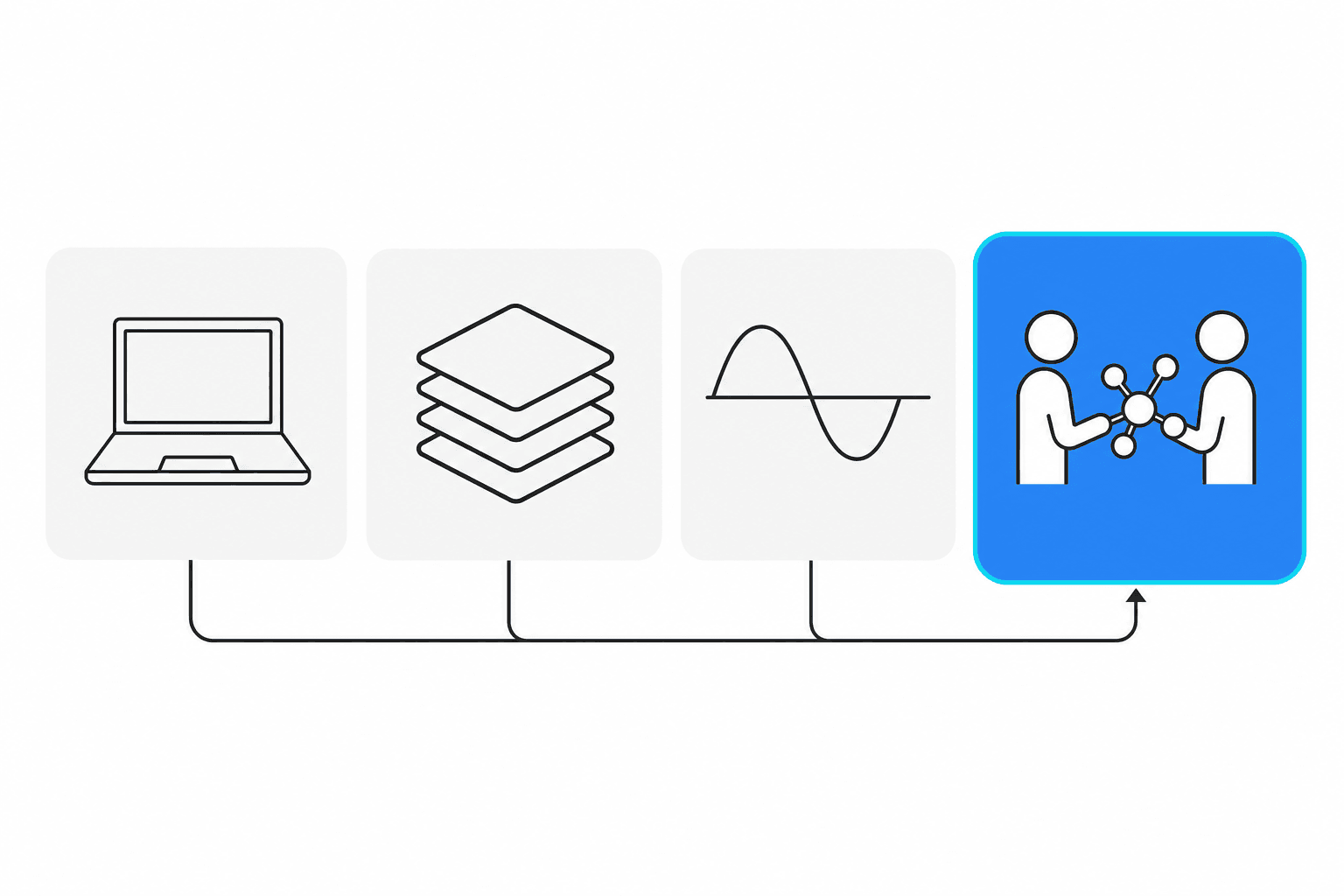 A flat diagram showing four tool categories in a row, with the collaborative spatial layer highlighted as the connecting step.
Sketching one small molecule on a laptop and minimizing it is Avogadro's home ground, and it costs nothing. Scripted physics at high volume is what Schrödinger and MOE were built for, and that trade-off gets a longer treatment in drug discovery software for computational chemistry. When the job is looking rather than building, the roundup of molecular visualization tools covers the viewers.
Nanome's half of the week is building, editing, and reasoning about structures in space, with colleagues in the room and the simulation-adjacent steps handed to MARA. It plugs into those suites instead of standing in for them. The case studies show what that looked like on live programs.
FAQ
What is molecular modeling software?
Software for building, editing, minimizing, and simulating molecular structures. Some packages specialize in a single step, and full suites carry the chain from structure through to physics.
What file formats does Nanome support?
Import covers the ordinary structure formats: PDB (.pdb, .ent), mmCIF (.cif, .mmcif, .bcif), SDF (.sdf, .mol), MOL/MOL2, SMILES, XYZ, PQR, and PDBQT (added in 2.6.0, converted to PDB with charges dropped). Vendor and session files come in too: Maestro .mae and .maegz, MOE .moe, and PyMOL .pse. On trajectories, .gro loads by itself, while .xtc, .trr, and .dcd attach to a model that's already open and have to match its atom count. Electrostatic .dx maps overlay a loaded model. Writing back out is narrower: PDB, SDF or SMILES, single frame, which leaves mmCIF, MAE, MOE and PSE import-only. More on supported formats.
Can I model molecules in VR?
Yes. Nanome runs on Meta Quest, Apple Vision Pro, HTC Vive Focus 3, and Pico Neo, so building, editing, and minimizing happen at true 3D scale. The browser app opens the same structures for anyone without a headset.
Does Nanome need a headset?
No. It runs in a browser and on Windows desktop, and one session can mix those with people who are in headsets.
Does Nanome replace Schrödinger or MOE?
It works alongside them. MOE, Schrödinger LiveDesign, and CDD Vault are all listed integrations, so structures move between Nanome and the suite while the heavy compute stays where it already runs.