The best AI tools for drug discovery are a stack of specialized models: AlphaFold 3 and Boltz-2 for structure prediction, RFdiffusion3 (beta) and ProteinMPNN for de novo design, docking engines, ADMET predictors, and generative chemistry. Nanome ties them together through MARA, an AI copilot that runs these tools from plain-English requests, shows you exactly what ran, and deploys behind your firewall.
No single model carries a project on its own, so the work runs as a chain: fold, dock, score, filter, repeat. Five categories cover most of it, and each one has more than one credible engine behind it.
Five categories, and what runs in each

Structure prediction. A sequence goes in, a 3D fold comes out. AlphaFold 3 is DeepMind's current public model, and Boltz-2 is one of several open engines that co-fold a protein together with its ligand. OpenFold3, Chai-1, ESMFold and Protenix cover similar ground with different tradeoffs, which is why running two of them and comparing the answers is ordinary practice.
De novo design. RFdiffusion3 draws protein backbones that don't exist yet, all-atom, with inference roughly 10 times faster than the generation before it. ProteinMPNN then writes a sequence that should fold into that shape. Between them you get a binder for a target no database has an answer for.
Docking. A protein and a small molecule go in, and the engine predicts the pose and scores the fit. Smina and DiffDock-L are the two engines MARA calls for this. Docking is cheap and noisy enough that the working unit is hundreds of runs.
ADMET. Absorption, distribution, metabolism, excretion, toxicity. A compound that binds beautifully and then fails on toxicity has already burned real time and money, so these predictors sit early in the funnel. eToxPred and ToxinPred handle the toxicity half.
Generative chemistry. The model proposes molecules against a target, scores them, and takes the survivors round again. Cheminformatics routines do the bookkeeping around that loop: similarity, properties, filtering, and the record of what got proposed when.
Stringing those calls into one long autonomous run raises its own questions, and agentic AI for computational chemistry works through them.
Comparison
| Model or category | What it does well | What Nanome and MARA add |
|---|---|---|
| AlphaFold 3, Boltz-2 | Structure and complex prediction | MARA calls either engine and colors the result by confidence; Nanome loads it in 3D |
| RFdiffusion3 (beta) | De novo protein backbone generation | MARA chains backbone, sequence and fold check from one request |
| ProteinMPNN, ANARCI | Sequence design; antibody numbering and CDR definition | MARA runs both across an antibody campaign |
| Smina, DiffDock-L | Pose prediction for hits | MARA docks and ranks; Nanome puts the top poses in front of the team at any scale |
| APBS | Electrostatics | MARA solves the field and Nanome paints it onto the surface |
| ADMET and toxicity models | Filtering on druglikeness and tox risk | MARA scores a series before anyone commits it to synthesis |
| Schrödinger, OpenEye, CCG MOE | Full comp-chem suites | Nanome integrates with all three and adds a shared 3D room on top |
Where Nanome and MARA fit
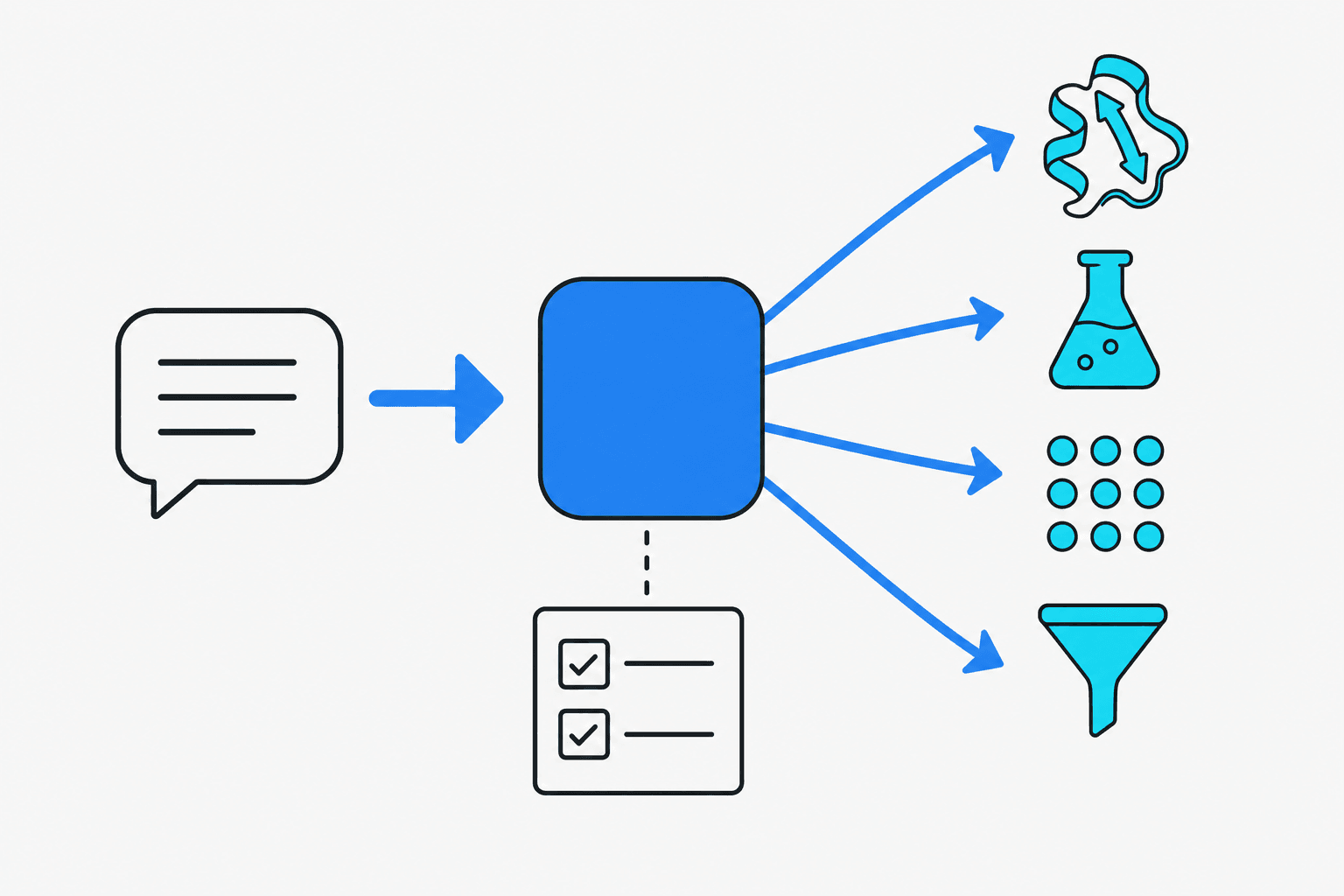 A plain-English request flows into a central hub that fans out to four specialized scientific tool icons, with a transparency log below.
Nanome is a collaborative molecular visualization and drug discovery platform. It runs in the browser, on Windows, and in XR on Meta Quest, Vive Focus 3, Pico Neo and Apple Vision Pro. Structures arrive by accession code from RCSB PDB, PubChem or DrugBank, or straight off a disk as PDB or SDF.
Nanome's copilot, MARA, reaches 300+ integrated scientific tools across 26 categories. It runs docking, co-folding, electrostatics and ADMET prediction, numbers antibody variable domains and marks their CDR loops with ANARCI, designs sequences with ProteinMPNN, generates backbones with RFdiffusion3, and predicts folds with Boltz-2 or AlphaFold 3.
Groups add their own code to that library. An in-house script, or a model a team trained on its own data, becomes a MARA tool that anyone in the org can then call by name in a sentence.
A request in plain English is enough. MARA picks the tool, runs it, and hands back a record: which tool fired, the inputs it took, the artifact it produced. When a colleague or a regulator wants to know where a number came from, that record is the answer. The day-to-day rhythm of working this way gets a fuller walkthrough in an AI copilot for drug discovery workflows.
Two properties of the setup carry most of the weight. Several people share one 3D session and study the same binding pocket at the same moment, in the browser or in a headset. And enterprise installs of Nanome and MARA sit inside your own network, as a single tenant in the cloud or on hardware you run, so an unpublished target stays where it started.
Insilico Medicine worked exactly that way on COVID-19. Their AI generated 10 novel SARS-CoV-2 protease inhibitors, and the medicinal chemists reviewed those molecules in Nanome in VR before the program went any further. The work was co-authored and posted to ChemRxiv. Insilico's CEO gave the reasoning:
"While AI can come up with novel and diverse drug-like molecules, it is important for medicinal chemists to look at these molecules closely before placing a billion-dollar, life-or-death wager. VR enables medicinal chemists to do this."
Alex Zhavoronkov, CEO, Insilico Medicine
The peer-reviewed record behind the platform is under publications.
When to run the model directly
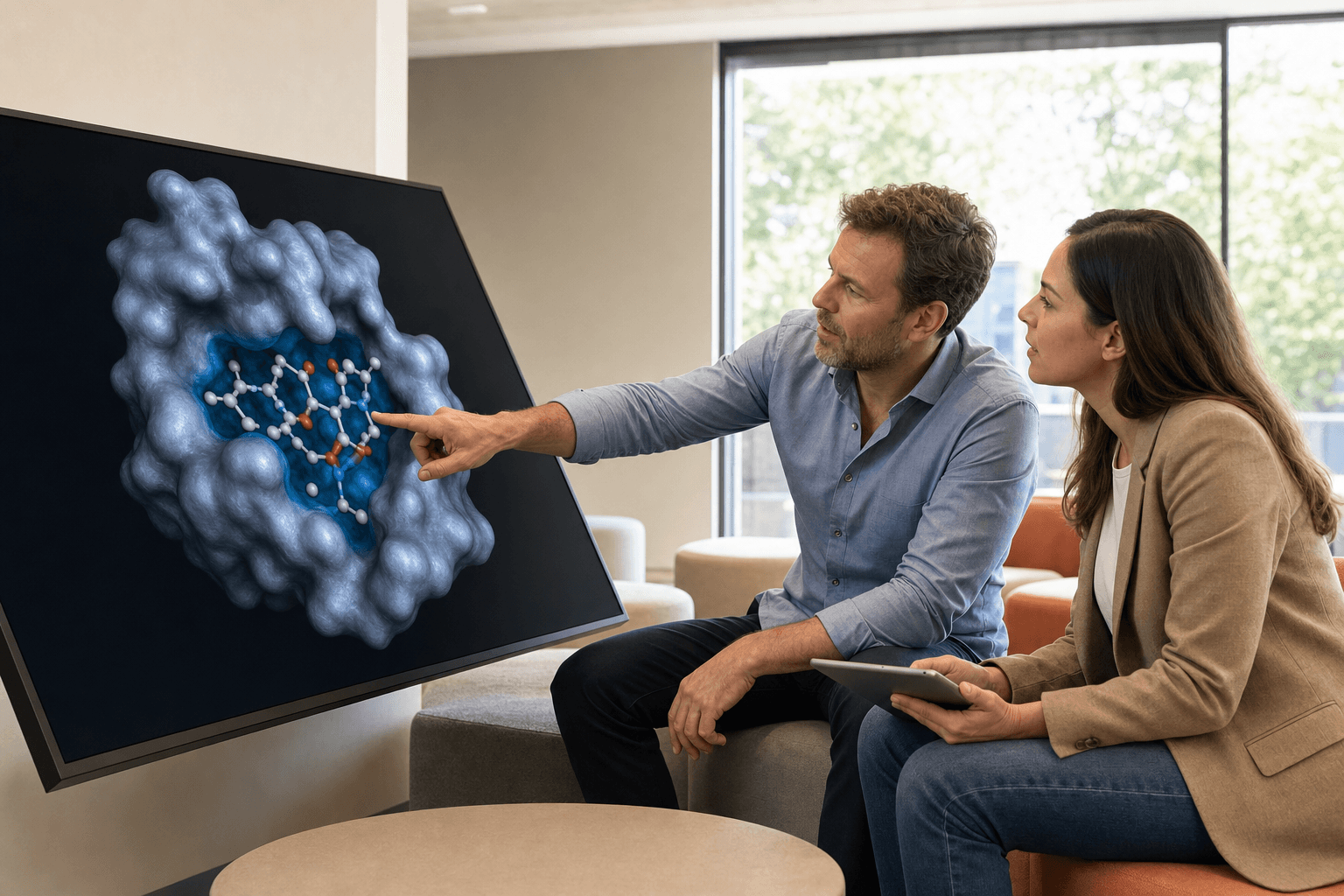 Two colleagues in a bright research lounge examine a protein-ligand surface model on a large display, one pointing at the binding pocket.
One model at volume belongs on a queue. Folding 10,000 sequences overnight, with nothing to visualize and nobody watching, is a job for AlphaFold 3 in a script, and a graphical interface adds nothing to it.
When the deep work of a project lives in Schrödinger Maestro, MOE or BIOVIA Discovery Studio, that is where it should stay. Nanome opens Maestro .mae and .maegz (the format LiveDesign hands over) and .moe files for viewing, and it parses the ordinary PDB, mmCIF, SDF, MOL/MOL2, XYZ and PQR a pipeline already writes. Molecules come back out as PDB, SDF or SMILES, one frame at a time. More on supported formats.
Nanome connects to CDD Vault, Cresset Flare, OpenEye (Cadence) and Schrödinger LiveDesign over an open REST API and MCP servers, so the output of a run lands next to the assay record it belongs with. What other groups have built on that footing is at nanome.ai/case-studies.
FAQ
What are the best AI tools for drug discovery?
Structure prediction runs on AlphaFold 3 and Boltz-2, with OpenFold3, Chai-1, ESMFold and Protenix alongside them. De novo design runs on RFdiffusion3 and ProteinMPNN. Docking runs on Smina and DiffDock-L, and ADMET plus toxicity models filter what survives. Nanome's MARA copilot reaches 300+ of these across 26 categories and drives them from a sentence.
What are AI-powered molecular analysis tools?
Software that predicts, generates or scores molecular structure with machine learning: folding models, binder generators, docking engines, electrostatics solvers and ADMET predictors. MARA runs them, and Nanome loads what comes back into a 3D workspace a whole team can join.
Can I run these models without writing code?
Yes. A request in ordinary English is enough. MARA selects the tool, runs it, and reports what went in and what came out, and the structures it produced land in the Nanome workspace ready to turn over.
Is my data safe with an AI copilot?
Enterprise deployments of Nanome and MARA sit inside your own network, as a single-tenant cloud instance or fully on-premises. Structures, sequences and the prompts you type stay in the environment they started in.