Structure-based drug design (SBDD) means using a target protein's 3D structure to design molecules that bind it. The best tools depend on the step you're on: full comp-chem suites like Schrödinger Maestro, MOE, and OpenEye handle docking and optimization, while Nanome adds a collaborative visualization and AI copilot layer (MARA) that runs docking, de novo binders, and electrostatics right on top of them. Nanome loads PDB and SDF structures across a browser, XR headsets, and Windows desktop, and plugs into the suites you already run.
What is structure-based drug design?
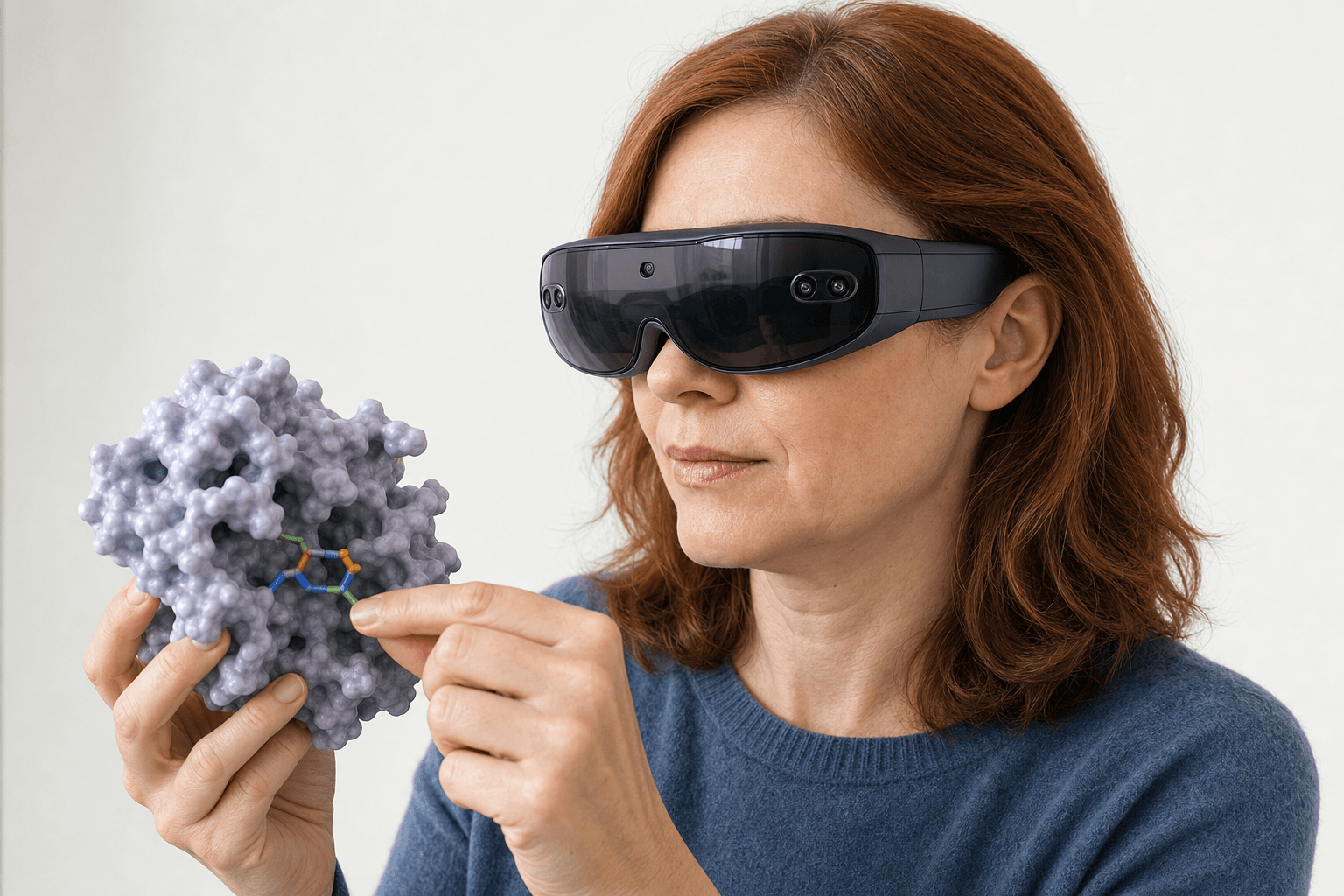 A researcher wearing an ultra-thin VR headset studies a solid protein surface model with a small ligand visible in its binding pocket held close to the chest
SBDD starts with a 3D structure of the target, usually a protein, and works out what small molecule or biologic fits its binding site. You look at the pocket, place candidate ligands, score how well they bind, then refine.
Ligand-based design goes the other direction, inferring a shape from molecules already known to work. With the pocket in front of you, hydrogen bonds, shape, and charge become things you can measure and argue about directly.
The workflow, step by step
Most SBDD projects move through 4 stages, and the package that suits one stage rarely suits all four.
- Get the structure. Pull an experimental structure from RCSB PDB, or predict one with AlphaFold 3 or Boltz-2 when no crystal exists.
- Find the pocket. Identify the binding site and map its shape, hydrophobic patches, and charged residues.
- Dock. Place candidate molecules in the pocket and score the poses.
- Optimize. Iterate on the best hits: tweak substituents, check ADMET, design de novo binders.
Comparison table
| Package | Strength | How Nanome pairs with it |
|---|---|---|
| Schrödinger Maestro / LiveDesign | Physics-based docking, free-energy perturbation, enterprise data | Nanome imports Maestro .mae and .maegz files, the same format LiveDesign ingests, and connects to LiveDesign, so a compound in the LiveReport comes up in shared 3D. Formats in detail |
| MOE (Molecular Operating Environment) | Structure prep, pharmacophores, medicinal chemistry workflows | MOE is a listed Nanome integration. Nanome reads .moe files, and MARA can dock or compute electrostatics on that same structure without a hand-off |
| OpenEye (Cadence) | Shape and electrostatic similarity, fast virtual screening | Nanome integrates with OpenEye, then puts the hit list in front of several people at once for a live pass |
| Cresset Flare | Electrostatics-driven design, field-based analysis | Nanome connects to Flare and puts the fields and the ligand in a room a group can walk around |
| PyMOL, ChimeraX, VMD | Desktop, script-driven structure viewing | Nanome opens a PyMOL .pse session for viewing (import only, and nothing writes back out as .pse), along with .pdb, .cif, .sdf, .mol2, .xyz, and .pqr. Saving a molecule back out means PDB, SDF, or SMILES, single-frame. Formats in detail |
Where Nanome and MARA fit
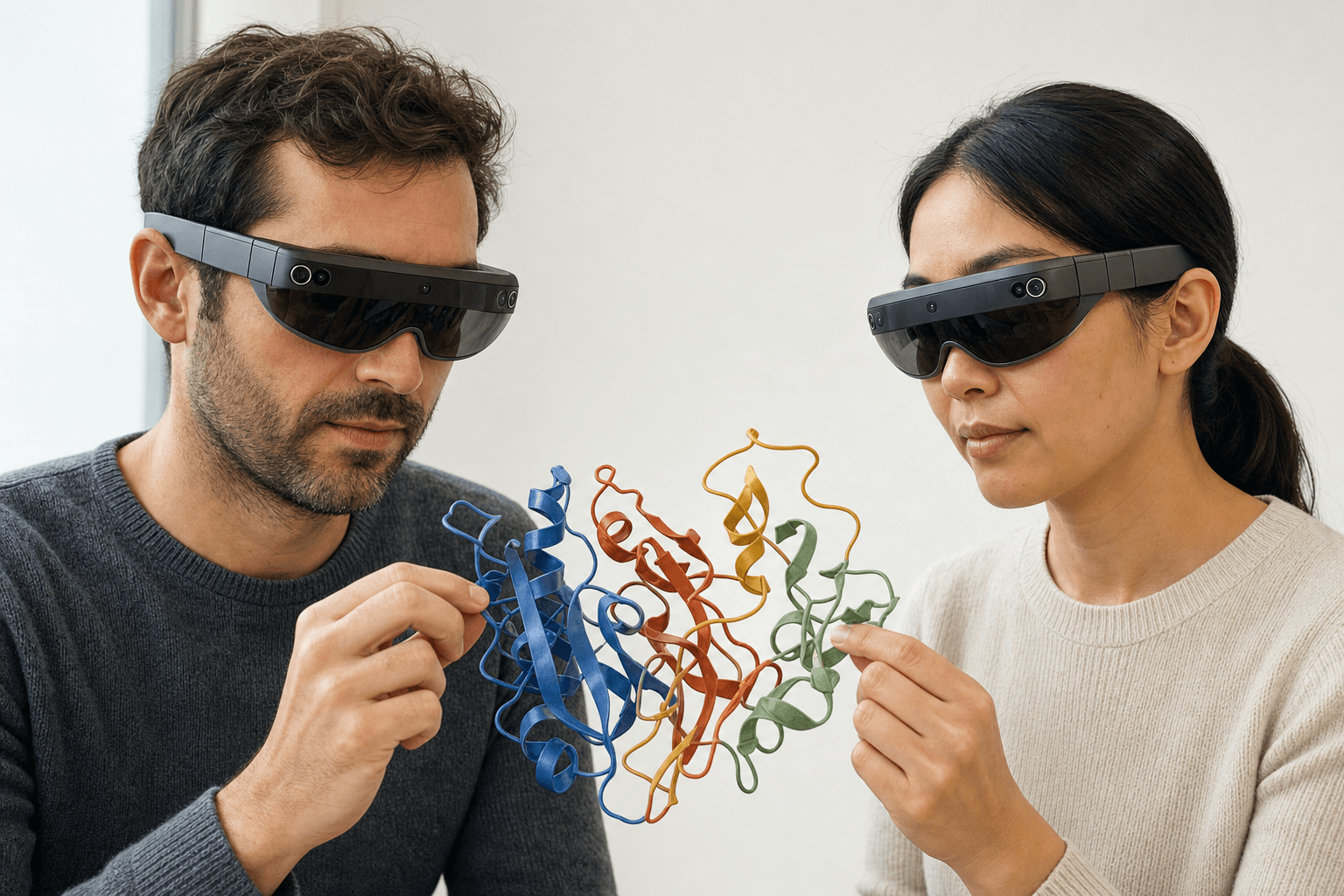 Two colleagues wearing ultra-thin VR headsets examine the same ribbon-cartoon protein structure floating between them
Nanome is a collaborative molecular visualization and drug discovery platform. It opens in a browser, on Windows desktop, and in XR headsets, and a structure looks the same in all three.
The AI copilot inside it is MARA. Describe a job in plain English, and MARA picks a tool, runs it, then names what it called, what went in, and what came back. Its built-in library covers 26 categories, and the full catalog is public.
Every one of the 4 stages above has engines waiting in there. Structure prediction and co-folding go through AlphaFold 3, Boltz-2, OpenFold3, or Chai-1. Docking runs on Smina or DiffDock-L. APBS handles electrostatics, ADMET models score the survivors, and RFdiffusion3 (beta) builds de novo binders. ProteinMPNN writes sequences onto a backbone, while ANARCI numbers and classifies antibody variable domains and marks their CDR loops. Structures come in from RCSB PDB, PubChem, and DrugBank.
Antibodies bend every one of those stages into a different shape, and software for computational antibody design follows that version of the pipeline.
Review is where the shared room does the most. A medicinal chemist, a structural biologist, and a computational chemist can stand around one pocket at the same time, so a question about which residue somebody means gets settled by pointing at it.
Past the four packages in the table, Nanome links to Collaborative Drug Discovery (CDD Vault), KNIME, and Jupyter, and exposes a REST API plus MCP servers, so it drops into a pipeline rather than asking for a new one.
When to use something else
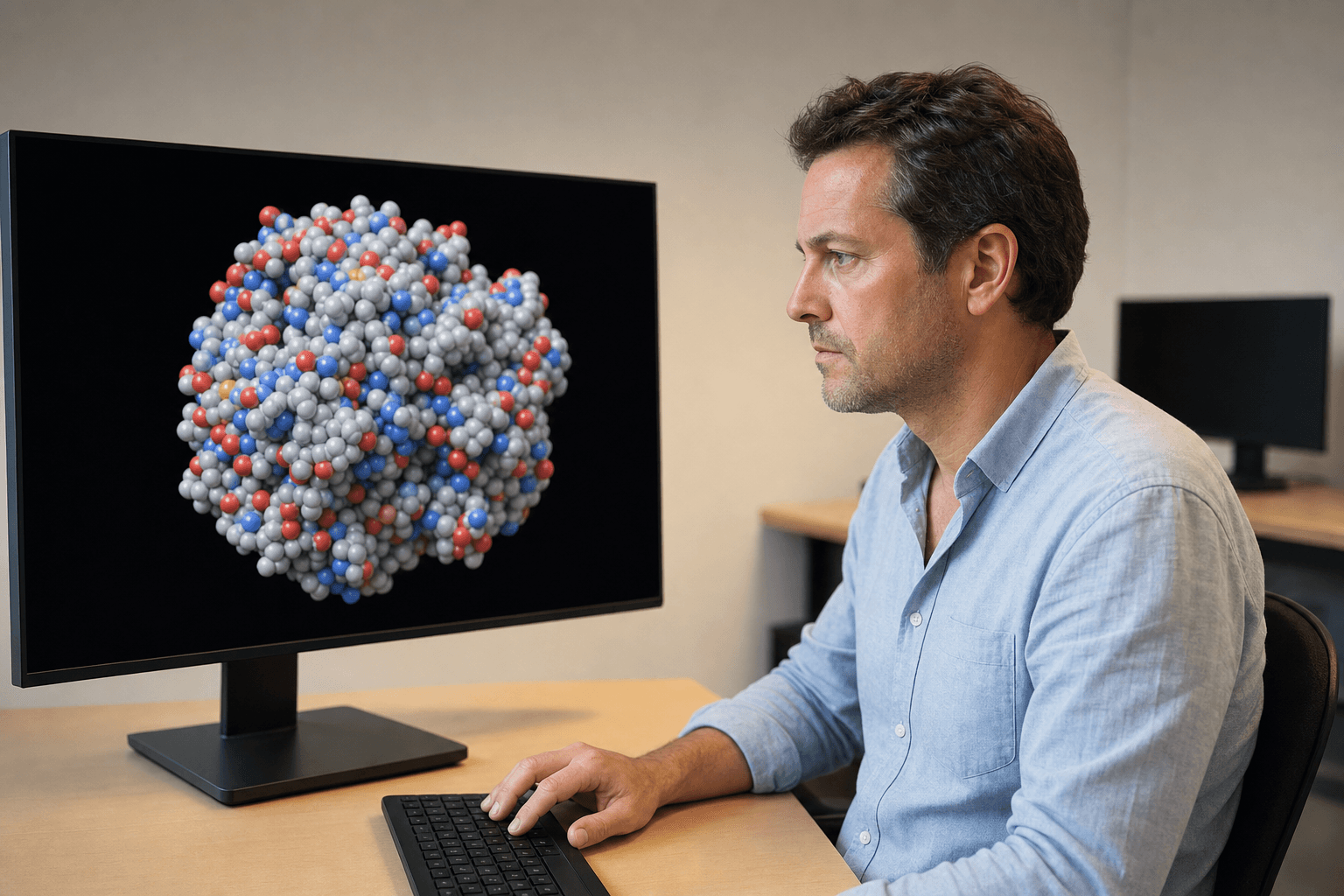 A researcher at a plain desk studies a space-filling protein model on a large monitor in a quiet computational office.
Free-energy calculations at production scale are a suite job, and Schrödinger is built for that arithmetic, with Nanome sitting above it for the looking and the deciding. A quick scripted edit on one structure is lighter work for a desktop viewer like PyMOL or ChimeraX. Nanome pays off when several people need the same pocket in front of them at once, or when an AI copilot is doing the running.
Viewers as a category get a head-to-head of their own in the best molecular visualization tools, and the wider stack around these 4 stages, from cheminformatics to data management, is mapped in drug discovery software for computational chemistry.
Some of this shows up in the literature. A team at Oak Ridge National Laboratory worked inside Nanome with its MedChem plug-in and built a new inhibitor of the SARS-CoV-2 main protease, Mpro. Hanging a chlorine atom off the scaffold made it bind the protease better, and the compound showed superior inhibition in vitro. The paper ran in the Journal of Medicinal Chemistry, where first author Dr. Kneller described the chemical structure as different from what the global community had studied before. If it clears further development, it stands as a candidate for the first drug anyone has discovered inside virtual reality. Nanome's case studies carry the write-up of that project, and of others like it.
FAQ
What is structure-based drug design?
Designing drug candidates from the 3D structure of the target. You read the binding pocket, place candidate molecules in it, score how they sit, then refine the ones that score well for potency and drug-like properties.
What are the best tools for structure-based drug design?
Schrödinger Maestro, MOE, and OpenEye each cover docking and optimization inside a full suite. Nanome adds shared 3D review over the top, in a browser or a headset, with MARA running docking, de novo binder design, and electrostatics on request.
Can I do docking without writing code?
Yes. Describe the job to MARA in plain English and it runs the docking, co-folding, or electrostatics, then reports which tool produced the result.
Does Nanome work without a VR headset?
Yes. There's a browser web app and a Windows desktop build, and headsets are optional: Apple Vision Pro, Pico Neo, Meta Quest, and HTC Vive Focus 3 all work.