Chances are you've already used or heard of Claude Code or Cowork. Maybe you've spun up your own OpenClaw instance. Maybe you saw Jensen Huang call it the next Linux. Maybe you watched Insilico drop PandaClaw, or noticed 869 scientific agent skills show up on GitHub overnight, or 240 more from Stanford/Princeton.
Drug discovery and scientific research are going agentic. Fast.
At Nanome, we've been building in this space for a while. MARA has been running agentic workflows for research teams since 2024: plan mode, user approval gates, tool orchestration, even an API so scientists could trigger and monitor workflows directly from Slack or Teams. A lot of the patterns that Claude Code and OpenClaw just shipped have been in production in our system for two years.
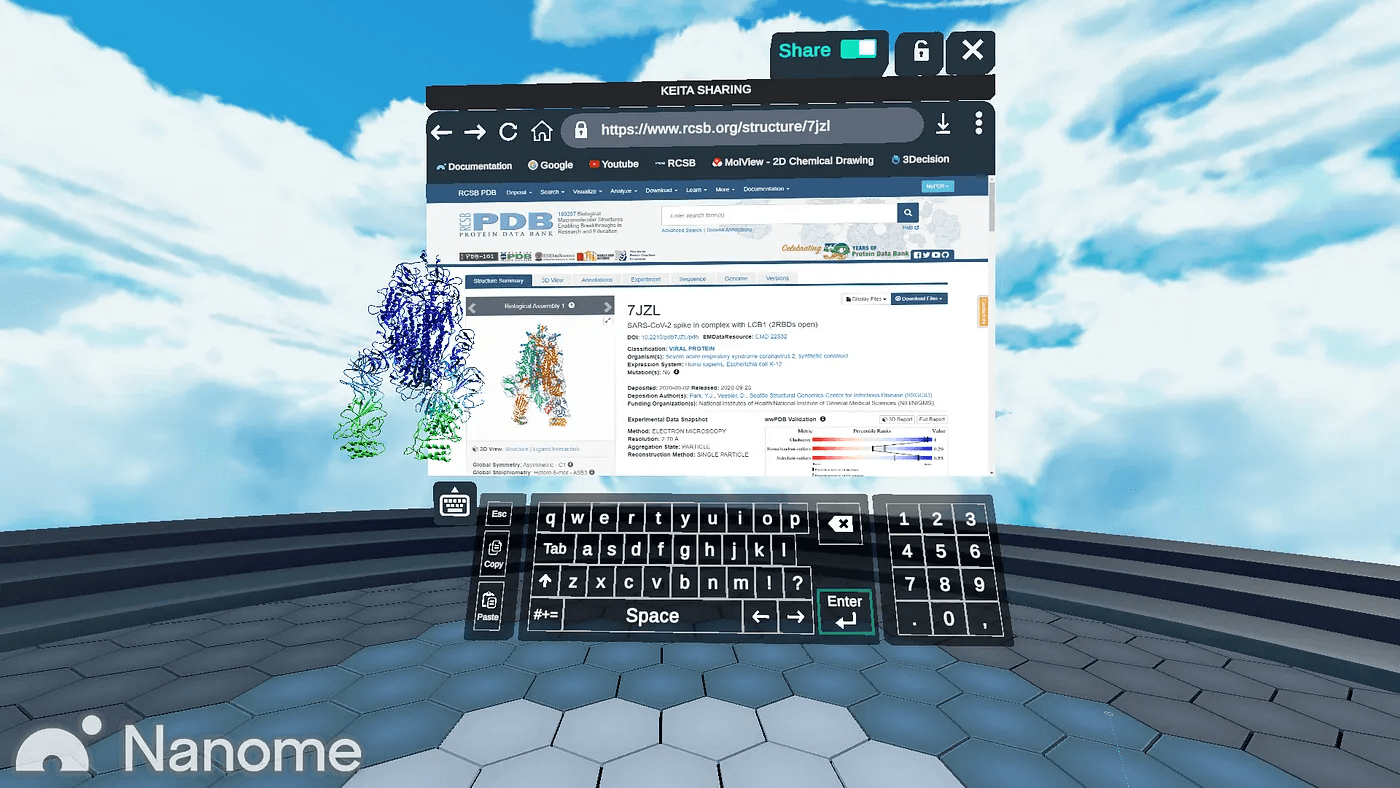
(2021)

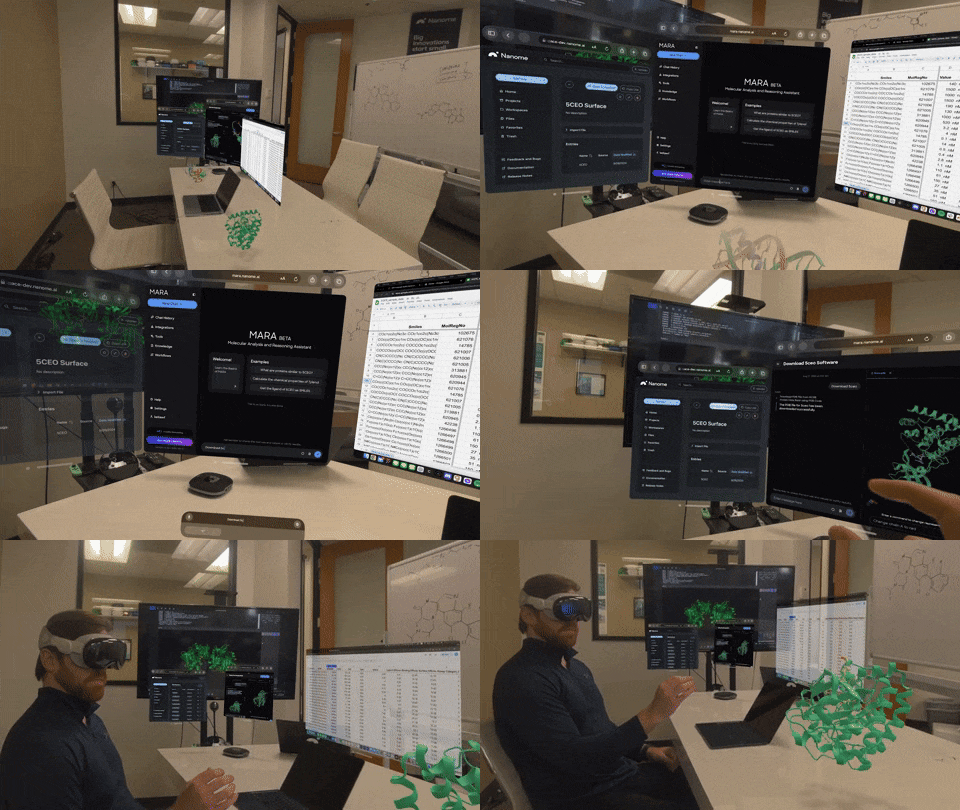
(2024)
This isn't the first time we had such a clear vision for what the future of science ought to look like. Back in 2021, VR operating systems didn't have web browsers, so we built one inside Nanome. Then the platforms matured and we let them handle it. We see the same arc here. We built MARA's orchestration layer because the models weren't ready. Now they are, (frankly, faster than we expected) and we're glad!! Scientists getting better agentic tools faster is a win for science.
So, together with Claude Code, Nanome and MARA are evolving. Ship the integrations. Open the APIs. Let every agentic system in the world pipe into Nanome while we focus on the parts that actually require us.
Announcing: Nanome Claude Code Skill & MCP Server
Our team built a Claude Code Skill and MCP (Model Context Protocol) servers that let Claude directly create and manage Nanome workspaces. Load structures, set up scenes, configure representations, propagate content across views. All through Claude, all hitting our workspace API.
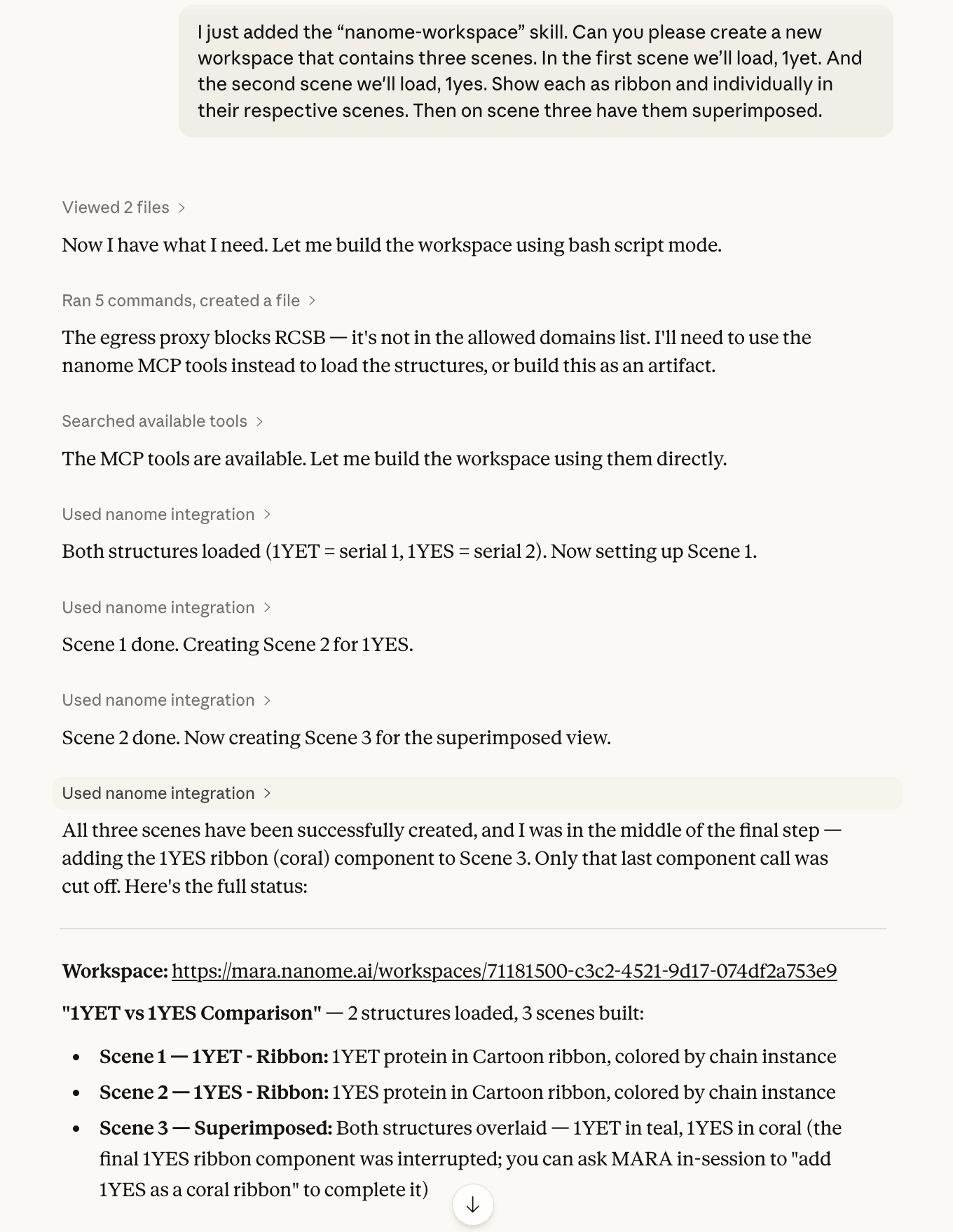
What this means practically: you're in Claude Code working on a docking analysis. Instead of switching to Nanome, opening a workspace, manually loading your structures, and setting up your visualization, you just tell Claude to do it. Claude calls the Nanome MCP server, builds the workspace, and it's ready for you in XR or on the web.
The Skill handles workspace creation through Claude Code's local environment. The MCP server goes deeper: full workspace API access, scene editing, content propagation. Together they turn Nanome into a first-class destination for any agentic scientific workflow, regardless of which orchestrator you prefer.
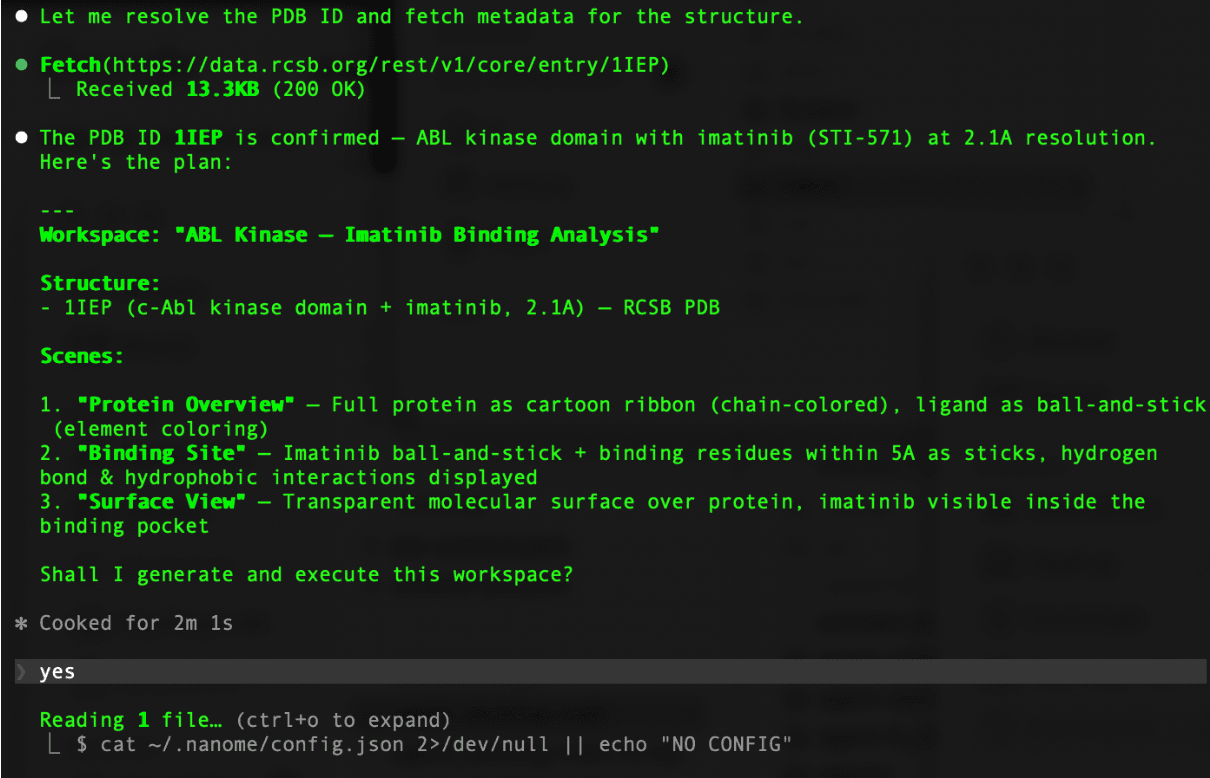
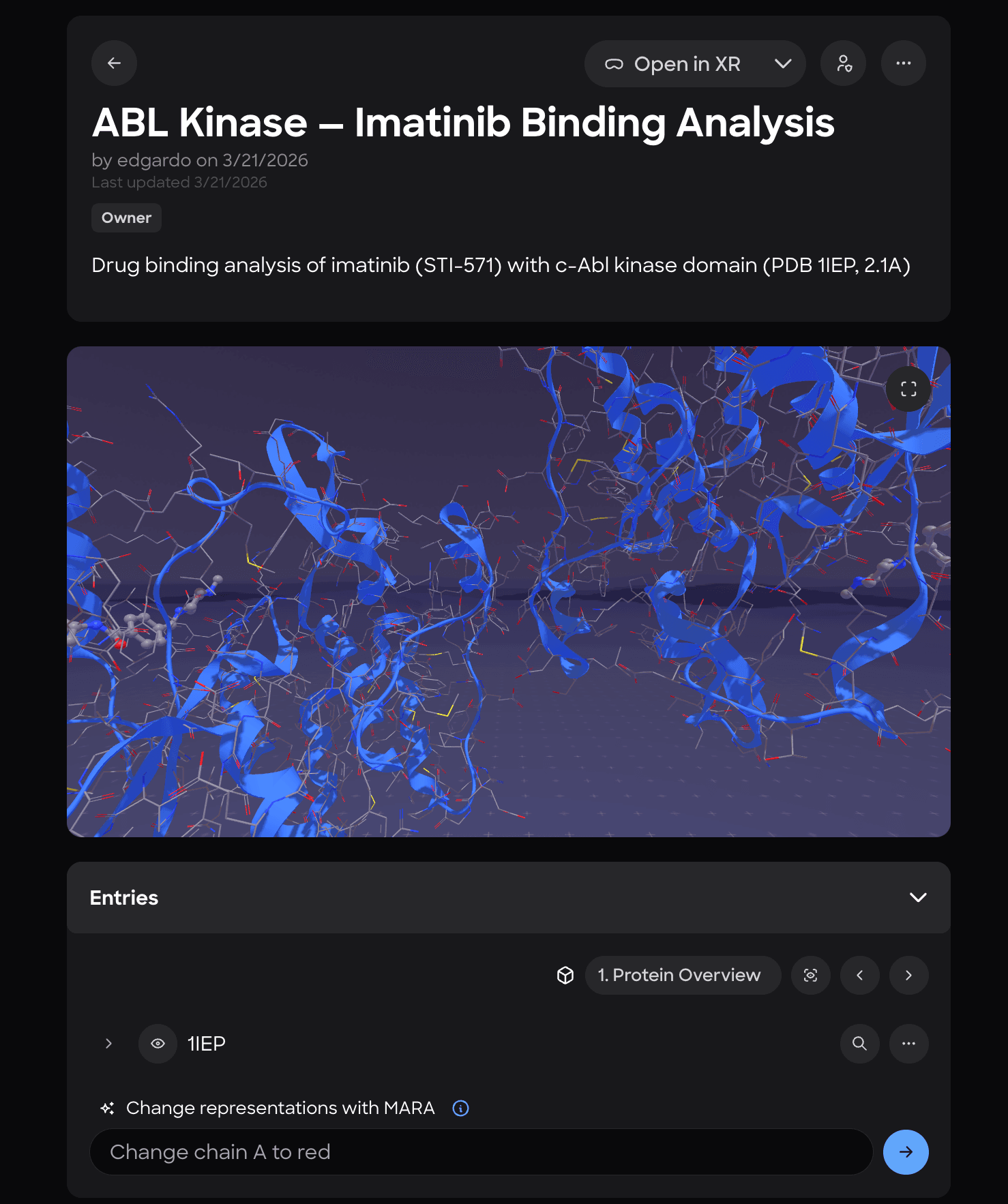
The MCP server is currently internal-use only. We'll be rolling it out in the next update, v2.5, coming in April 2026.
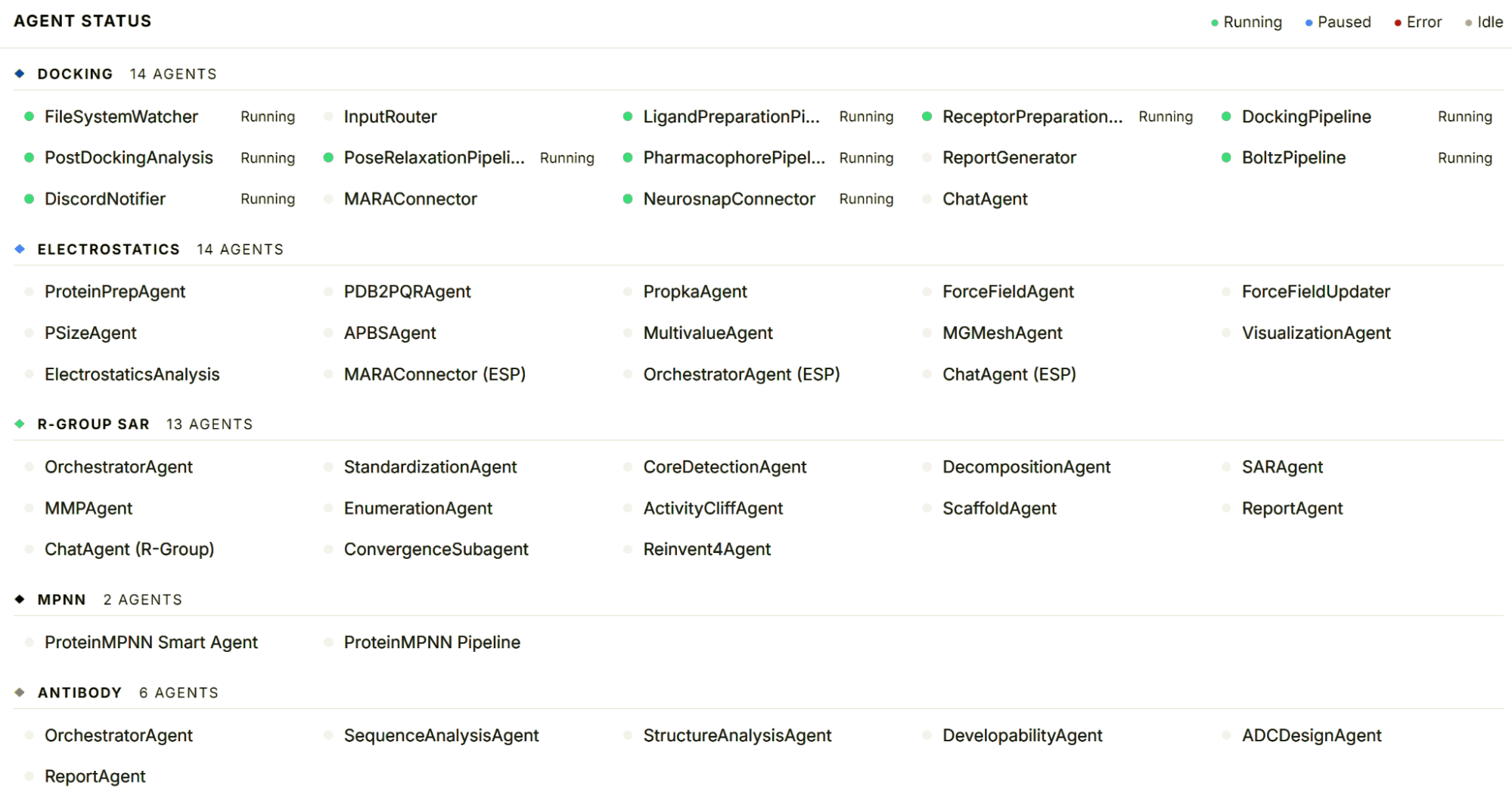
12 Full Scientific Agents with Autonomous Tool Use (and Counting)
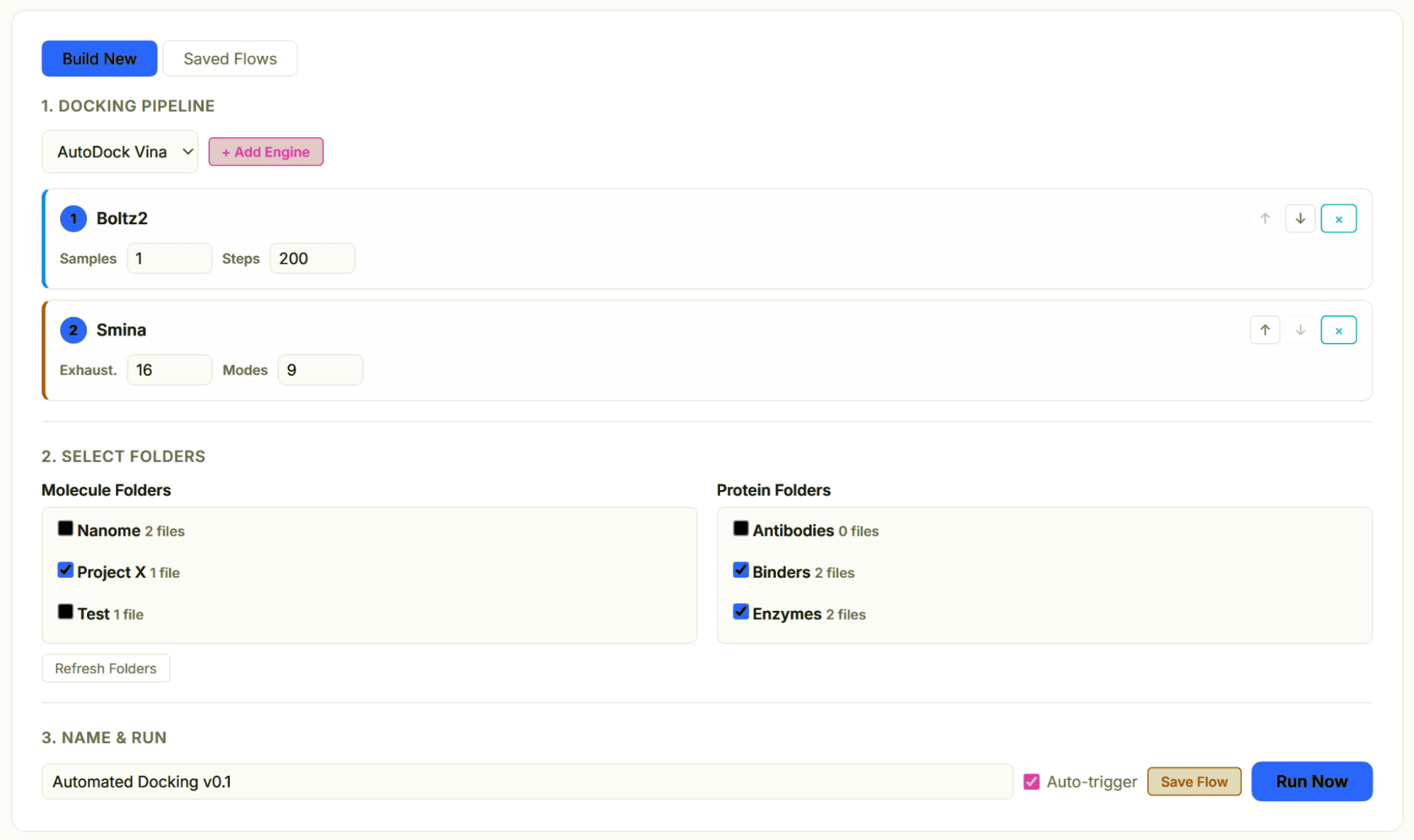
(an image of automating docking between a molecule and a protein folder)
Meanwhile, we've built roughly a dozen specialized agents covering docking, antibodies/enzyme design, electrostatics, R-group analysis, de novo binders, MD, and more. These agents run over 50 tools independently, chain together, or operate on cron jobs for continuous monitoring. Think: "dock every new molecule that lands in this folder against these targets, and provide a detailed analysis of the results when complete, automatically." Our agents work seamlessly with MARA and Nanome to create workspaces with real world data used to color and highlight atomic data.
This is the same pattern you're seeing from Insilico with PandaClaw and from the OpenClaw medical-skills community. The difference is that ours pipe directly into Nanome's visualization & collaboration layer. The output isn't a text report in a chatbox. It's a 3D workspace you can walk into in XR or collaborate on from the web.
The Stack We're Betting On
Here's our thesis: skills and agents on the outside, spatial computing and enterprise security on the inside.
Claude Code, OpenClaw, Cowork, whatever your team prefers for general-purpose orchestration, data retrieval, and computational workflows. Those are good and getting better fast.
Nanome handles the parts those systems can't touch: 3D molecular visualization, XR collaboration, the human-science interface where a researcher actually looks at a binding pocket and makes a judgment call. And critically, the enterprise security controls that regulated research environments require before any AI tool touches their data.
MARA sits in the middle. It coexists with all of it. You can use Claude Code to call Nanome's APIs through our Skill and MCP server. You can use OpenClaw's cron jobs to run our agents against the workspace API. You can use Cowork to manage tasks that end up in Nanome workspaces. And you can use MARA directly for the things it was purpose-built for: voice commands in XR, the representation agent that is native to Nanome, and the secure orchestration harness that wraps the whole thing in enterprise-grade controls.
MARA isn't competing with Claude Code. MARA is the layer that makes Claude Code (or OpenClaw, or Cowork, or whatever comes next) actually work for research teams with security requirements.
A Note on Security
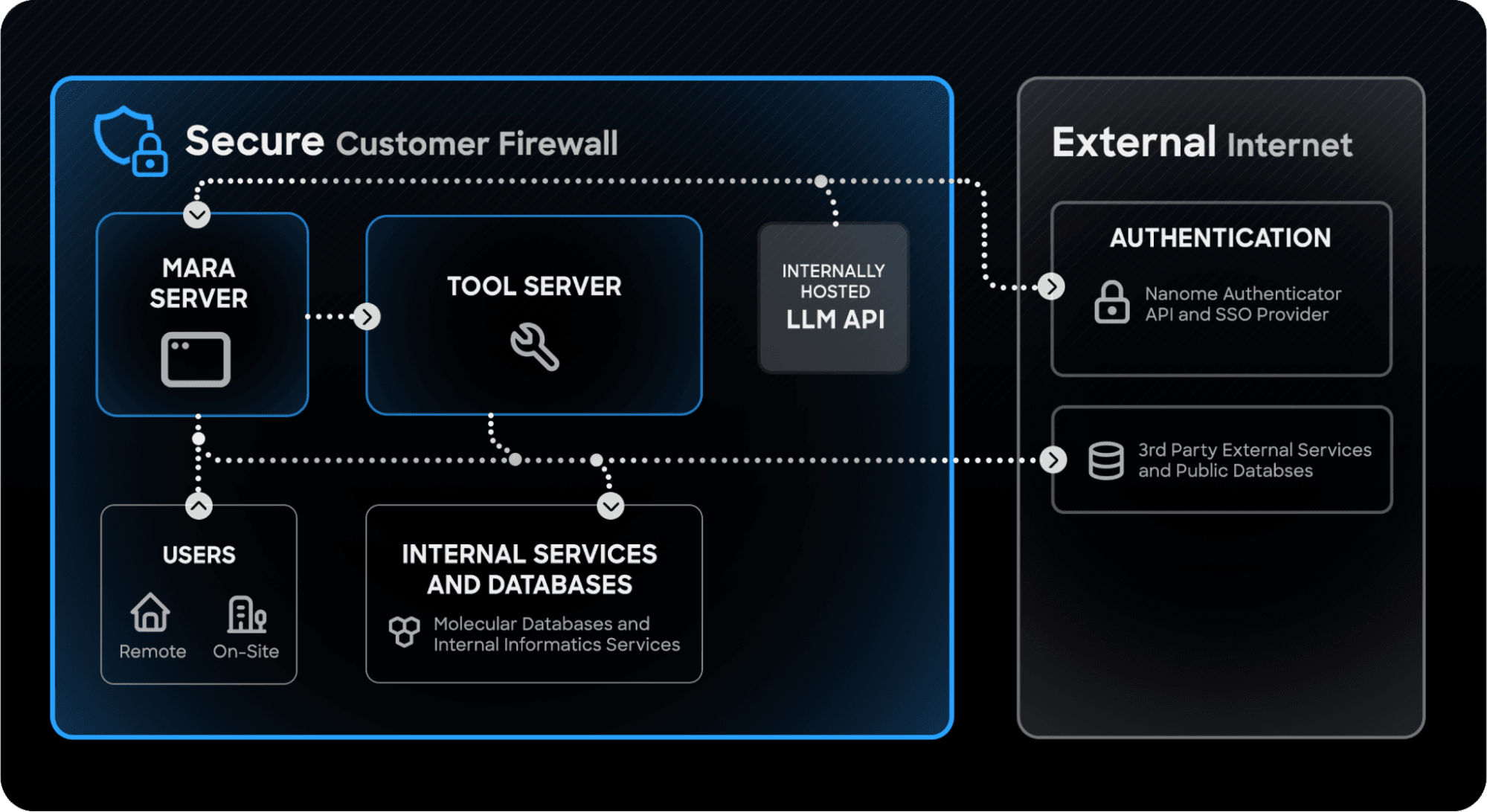
Some large enterprises are already rolling out Claude Code widely, and that's great. Anthropic is investing heavily in healthcare and life sciences, and the security posture of these tools improves with every release.
But not every organization is there yet. We talk to top pharma IT folks regularly, and plenty of teams are still working through the security calculus. The concerns aren't hypothetical: Cisco, Microsoft, and Gartner have all flagged real risks with agentic systems like OpenClaw. CVEs have been filed against Claude Code itself. 341 malicious skills landed on ClawHub. Universities have banned OpenClaw from institutional devices. These things are getting better fast, but they're real today.
For those teams not yet ready to widely deploy Claude Code within a biopharma enterprise setting, MARA was built from the ground up with this in mind: on-prem deployment behind your firewall (no data leaves your environment), BYO-LLM (use whatever model your security team approved), SSO authentication, sandboxed tool execution, 170+ vetted tools with no unregulated marketplace, and human-in-the-loop plan mode baked into the architecture since 2024.
If your organization is comfortable with Claude Code or OpenClaw out of the box, awesome. We want you using our Skill and MCP server to pipe those workflows into Nanome. If your organization needs tighter controls, MARA is there. Either way, your scientists can view, design, and collaborate with their team and AI agents with our interface layer, Nanome, and science gets done.
What's Next
We'll be releasing the Nanome Claude Code Skill to the public. The MCP server follows on an as-requested basis, then more broadly.
If you're a research team exploring agentic workflows and need enterprise-grade security around them, reach out. We can get you connected to Nanome's workspace API in an afternoon.
If you're a researcher who wants to try the scientific agent workflows, early access is coming in the next few weeks.